Birth Chart Basics
Did Your Zodiac Sign Change? Sidereal Astrology, Ophiuchus, and the 13th Sign
Your zodiac sign didn't change. Signs are equal slices tied to the seasons, not the stars. Here's what precession, sidereal charts and Ophiuchus mean.

The headline hits your feed on a random weeknight and for about four seconds you genuinely wonder whether every horoscope you've loved belonged to someone else. Your friend's chart app called you a Cancer, a video announced a thirteenth sign called Ophiuchus, and now a party acquaintance is Googling on his phone while insisting December birthdays are "secretly Ophiuchus." Take a breath. Your sign hasn't changed. It hasn't been wrong. Every one of these stories is mixing up three different things: the stars in the sky, the twelve equal slices Western astrology uses, and a separate system that Indian astrology keeps anchored to the stars. Once you see those three as separate, the headlines stop rattling you. And nothing about your chart needs to move.
Signs and constellations aren't the same thing
Here's the mix-up that starts everything. A zodiac sign is one of twelve equal 30-degree slices laid along the Sun's yearly path. A constellation is a group of stars someone drew a picture around a few thousand years ago, and those star groups come in wildly different sizes. They're not interchangeable. They just share names.
The Sun lines up with Virgo for about 45 days but with Scorpius for only about 7.[1] That's the math behind the meme: if signs were actual constellations, every sign would cover a different chunk of the year, and the whole twelve-part wheel would fall apart. The signs borrowed the constellations' names early on, and that shared name is the root of every "well, actually, you're really a..." conversation you'll ever have. From here on, sign means the equal slice. Constellation means the stars. Two different things wearing the same name.
The slow wobble that moved the stars
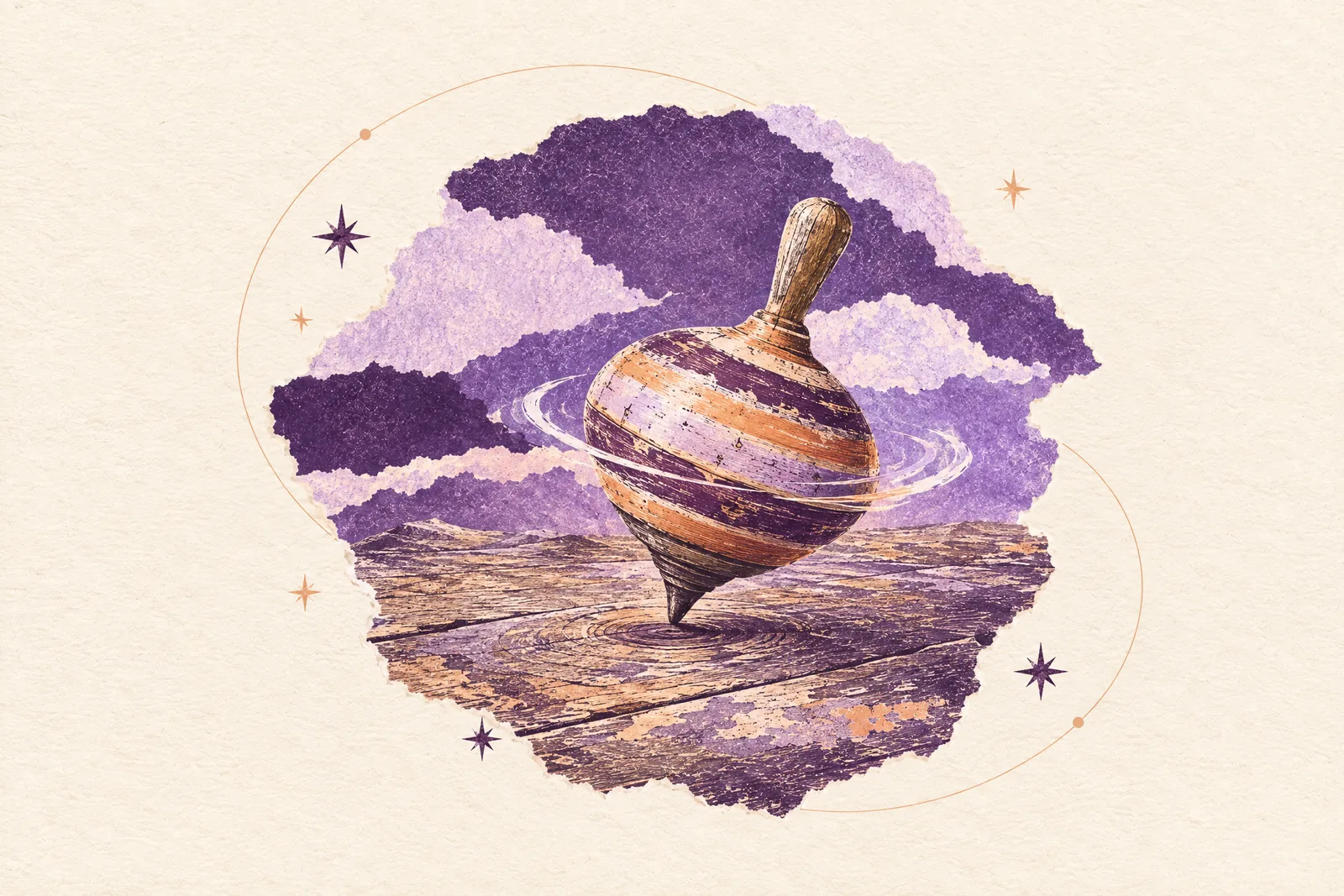
Earth spins like a slightly off-center top, and the direction its axis points traces a slow circle with a cycle of about 25,771.5 years.[2] That wobble is called axial precession, and it means the point in the sky where the Sun sits at the March equinox slides backward through the constellations at roughly one degree every 72 years.
Around two thousand years ago, the twelve equal signs and the twelve constellations roughly lined up. The March equinox sat at the edge of the stars we call Aries. Today it sits in front of Pisces. So yes, the sky has shifted. But the signs didn't shift with it, and that's deliberate. Greek astronomers knew the equinox was drifting, a discovery credited to Hipparchus around 130 BC, and Ptolemy, writing roughly three centuries later, described the convention of counting the zodiac from the vernal equinox and calling that point the first degree of Aries.[3] Nobody forgot to update anything. The tropical zodiac was built to follow the seasons, not the stars. Your Leo Sun means the Sun was in the fifth 30-degree slice counted from the March equinox, high summer in the Northern Hemisphere. That definition hasn't moved since Ptolemy described it.
Think of it this way. Your birthday lands on the same date every year, but the day of the week it falls on keeps shifting through the calendar. The signs are the date. The constellations are the weekday. They used to line up, they don't anymore, and neither one is broken.
Sidereal astrology: why some charts give you the sign before
Your friend's app isn't glitching, and it isn't secretly right about you. It's using sidereal astrology, the system at the heart of Vedic (Hindu) astrology, which keeps its twelve signs anchored to the actual stars rather than to the equinox. It corrects for the wobble with a measure called the ayanamsa, and the Lahiri ayanamsa is the most widely used.[4] The offset between the tropical and sidereal zodiacs was about 23.8 degrees in 2000 and sits at about 24.2 degrees today.[5]
Because that gap is most of a 30-degree sign, anyone whose tropical Sun falls in roughly the first 24 degrees of a sign gets bumped to the previous sign in a sidereal chart. That covers about four out of five birthdays. If you're a Leo, the odds are good your sidereal Sun sits in Cancer, and your friend's app is working exactly as designed.
Both systems are internally consistent. They measure from different starting points and answer different questions. Western tropical astrology ties your signs to the seasons. Vedic astrology ties its signs to the stars. Vedic astrology also divides the sky into 27 lunar mansions called nakshatras (28 in some counts), each 13 degrees 20 minutes wide when the 27 are divided equally, which is a whole other layer to explore. A sidereal chart is a parallel system with its own traditions and methods, not an upgrade or a correction to your tropical one. Read it separately, not as an overlay.
Ophiuchus and the "13th sign"
Ophiuchus, the Serpent Bearer, is a real constellation. Under the official constellation boundaries astronomers drew in 1930, the Sun passes in front of it from about late November to mid-December, tucked between Scorpius and Sagittarius on the sky map.[6] That's astronomy. The Sun really does cross thirteen constellations on its yearly path, not twelve.
But Ophiuchus has never been a sign in traditional tropical or sidereal astrology, because both systems divide the ecliptic into twelve equal slices rather than following irregular constellation boundaries. The "thirteenth sign" idea traces back to a 1970 book proposing a fourteen-sign zodiac, and a thirteen-sign version surfaced again in 1995. It made headlines in January 2011 after an astronomer at the Minnesota Planetarium Society made a statement about it, and then blew up again in 2016.
So an early-December Sagittarius hasn't become an Ophiuchus. That person was born while the Sun happened to be in front of a constellation called Ophiuchus. That's an astronomy fact, like knowing which streetlight you walked past on your way to work. It doesn't reassign your sign, and it doesn't come with a personality description, a ruling planet, or a horoscope section.
What NASA actually said
In September 2016, a NASA Space Place education post about the zodiac constellations went viral, and the coverage quickly turned into "NASA changed the zodiac." NASA's follow-up on their Tumblr was blunt and, frankly, funny: "Here at NASA, we study astronomy, not astrology. We didn't change any zodiac signs, we just did the math." They explained that the Sun passes through thirteen constellations, not twelve, and that the sky has shifted since the Babylonians because Earth's axis doesn't point in quite the same direction anymore.[1:1]
That's the wobble from earlier, restated by NASA itself. The math checks out. The zodiac didn't change. A constellation boundary was never a sign, and now you know exactly what that NASA post was talking about the next time it resurfaces.
What this means for your chart
Open your chart app, find the setting that says "tropical," and leave it exactly where it is. Unless you deliberately flipped a sidereal setting somewhere, every placement in your chart was calculated the tropical way, and nothing about them has budged. Nothing to redo. Nothing to re-read with a guilty feeling.
If a sidereal chart intrigues you, go for it. Pull one up, compare it to your tropical one, notice where the signs shifted, and read each chart in its own system's language. Mixing a sidereal Sun into a tropical Moon reading gives you neither. Two systems, two charts, two sets of notes. You get more information that way, not less.
And one quick sidebar: birthdays near a sign change, usually somewhere around the 19th to the 23rd of the month, are a completely separate question from all of this. That's about the Sun crossing a boundary on a particular day, which depends on your birth time and has nothing to do with precession or Ophiuchus.
Same sky, same you
You've been reading the right horoscope your whole life. The sky did its slow wobble. NASA did its math. Ophiuchus is still up there between Scorpius and Sagittarius, doing constellation things. Your friend's Vedic app is doing what Vedic apps do. None of it moved your sign, because your sign was never pinned to those particular stars in the first place.
It was pinned to the season. To the moment the days turn long and warm, to the height of summer, to the edge of autumn. To the slice of the wheel that Greek astronomers defined over two thousand years ago and that every tropical chart app still calculates today. Your Leo Sun is still your Leo Sun. Your Moon is still your Moon. Your rising is still your rising.
And now, the next time someone waves their phone at you and says "actually, NASA says," you can smile, tell them about the wobble, and go right back to reading your chart with the same confidence as always. The sky story is yours now, and it makes the whole wheel mean a little more.
NASA, Constellations and the Calendar, NASA's official Tumblr, 2016. ↩︎ ↩︎
NASA Science, Milankovitch (Orbital) Cycles and Their Role in Earth's Climate, section on precession. ↩︎
Wikipedia, Zodiac, sections on history and on the tropical and sidereal zodiacs. ↩︎
Wikipedia, Sidereal and tropical astrology, introduction. ↩︎
Wikipedia, Ophiuchus (astrology), introduction and history. ↩︎