Planets and Points
Ruling Planets: Which Planet Rules Your Sign, and Why It Matters
A ruling planet works like a family resemblance. Here's the tidy pattern behind the table, why three signs have two rulers, and how to follow each one.

You've got two screenshots of a zodiac table saved in your phone. One lists Scorpio's ruler as Mars. The other says Pluto. You've been quoting whichever one wins the argument, and neither feels like the whole story. Here's the good news: they're both right, and once you see why, the entire ruling planet table clicks into place like a pattern you can actually remember.
What "ruled by" actually means
A ruling planet is more like a family resemblance. Aries moves the way Mars moves. Mars is drive, assertion, the impulse to act now, and Aries moves exactly that way, first through the door, past the argument once it's over. Venus is attraction, pleasure, and value, and Taurus savors things the way Venus does: the good bread, the eight-year-old sweater, loyalty to what it loves. Mercury is thinking and exchange, and Gemini and Virgo are the two signs most occupied with information, one collecting it, one sorting through it.
"Rules" is old vocabulary for that likeness, the way a kid can have her aunt's laugh. The planet doesn't decide anything for you. But understanding how a planet works gives you a shortcut into every sign it governs. Learn Venus once, and you've just learned something real about both Taurus and Libra.
The Sun and Moon: one sign each
The Sun sits with Leo. Vitality, warmth, the wish to be fully and visibly yourself, that's the Sun's function expressed through a fixed fire sign. The Moon sits with Cancer. Care, feeling, memory, the instinct to make a safe place for the people you love, that's the Moon's function expressed through a cardinal water sign.
Each luminary rules exactly one sign, and those two signs sit right next to each other in the zodiac. Ptolemy wrote this up in his Tetrabiblos in the 2nd century CE. He explained that Cancer and Leo, being the most northern signs and the closest to the overhead point for his readers, were assigned to the Sun and Moon.[1] That's his reasoning, not a law of the sky, and the pattern does the rest.
One planet, two signs
Now look at the rest. Every other classical planet takes two signs, and the pairs read as two sides of the same function.
Mercury rules Gemini and Virgo. Gemini is Mercury in mutable air: questions, conversation, quick connections, ideas collected from everywhere. Virgo is Mercury in mutable earth: sorting, checking, testing, turning information into something useful. Picture a Virgo friend color-coding the grocery list while a Gemini friend narrates the store's gossip: the same planet runs both operations. Gemini asks what's out there. Virgo asks what's worth keeping and how it works.
Venus rules Taurus and Libra. Taurus is Venus in fixed earth: pleasure you can touch and keep, the long meal, the texture, the comfort of a thing you love enough to hold onto. Libra is Venus in cardinal air: pleasure found between people, in grace, fairness, good company, the right word at the right moment. Taurus enjoys. Libra relates. Both have strong taste, and both notice when something is out of balance, one in a room, the other in a conversation.
Mars rules Aries and Scorpio. Aries is Mars in cardinal fire: open, fast, and quick to move on after a fight. Scorpio is Mars in fixed water: focused, private, strategic, holding a goal or a grudge for a very long time. Aries fights in the open. Scorpio plans. Same planet, completely different expression.
Jupiter rules Sagittarius and Pisces. Sagittarius is Jupiter in mutable fire: the big trip, the big question, candid optimism, faith in the next horizon. Pisces is Jupiter in mutable water: generosity of feeling, imagination without edges, compassion that keeps widening. Sagittarius expands outward, toward places and ideas. Pisces expands inward and around, toward people and feelings.
Saturn rules Capricorn and Aquarius. Capricorn is Saturn in cardinal earth: ambition built step by step, standards you hold yourself to, patience with long projects. Aquarius is Saturn in fixed air: principles, systems, the rules a group lives by, and the stubbornness to keep an idea alive. Your Aquarius friend skips every wedding tradition, then runs her own seating system to the letter. That's Saturn doing its thing, just in air.
The pattern hiding in the table
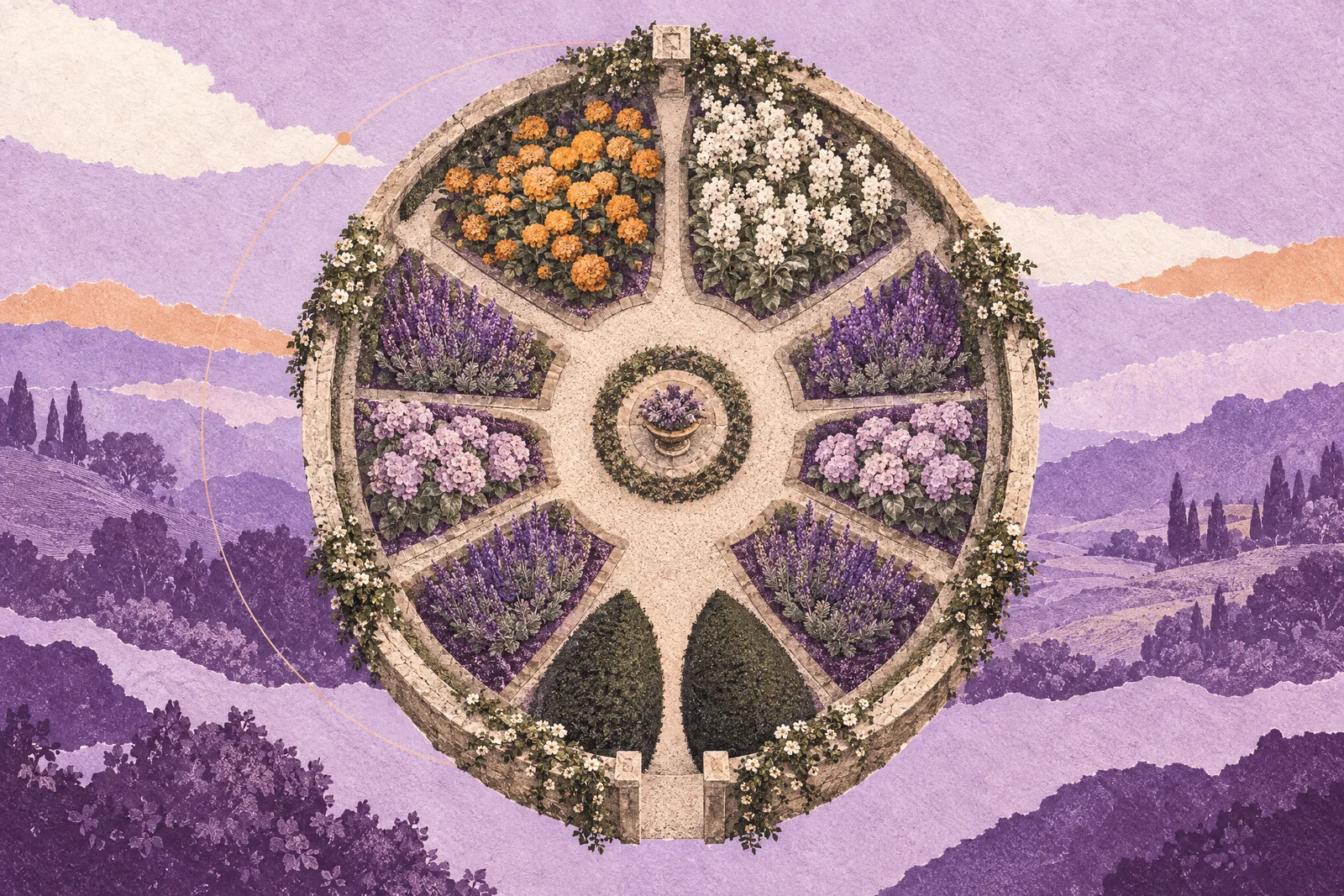
Draw the zodiac as a circle and the scheme turns tidy. The Moon and Sun hold Cancer and Leo, side by side. Moving outward on both sides, Mercury takes the next pair, Gemini and Virgo. Then Venus, Taurus and Libra. Then Mars, Aries and Scorpio. Then Jupiter, Pisces and Sagittarius. Saturn caps the circle at Capricorn and Aquarius, the signs directly across from the luminaries.
That answers the question people ask most. Mercury and Venus rule two signs each because every classical planet except the Sun and Moon does. Ptolemy recorded this whole arrangement, and he called a planet's pair of signs its "houses."[1:1] That's an old use of the word with no connection to the twelve houses of a birth chart.
Scorpio, Aquarius, and Pisces: why they have two rulers
Uranus, Neptune, and Pluto were discovered long after the old scheme was set, in 1781, 1846, and 1930. Modern astrologers paired them with Aquarius, Pisces, and Scorpio.[2] The traditional ruler stays in the first seat. The modern one joins as a second voice.
Think of it as layers, not replacements. Scorpio starts with Mars and adds Pluto's themes of power, intensity, and transformation. Aquarius starts with Saturn and adds Uranus's independence, innovation, and appetite for change. Pisces starts with Jupiter and adds Neptune's dreams, ideals, and blurred boundaries. The modern planets move so slowly they color a whole generation. Uranus takes about 84 years to orbit the Sun, Neptune about 165, Pluto about 248. Each stays in one sign for years, which is why they shape a generational feel more than a personal style.
When you read Scorpio, Aquarius, or Pisces, you start with the traditional ruler and add the modern one. Saying "Scorpio is ruled by Pluto, full stop" leaves half the story out.
Your Sun sign's ruler vs. your chart ruler
People get tangled because the same words mean two things. A horoscope calls the ruler of your Sun sign "your ruling planet." If you're a Libra, that's Venus, every time, for everyone who shares your Sun sign. Chart readers usually mean something different: the chart ruler, the traditional ruler of your rising sign.
A Libra Sun with Sagittarius rising has Venus as their Sun sign's ruler and Jupiter as their chart ruler. Both are worth knowing. They tell you different things. The Sun sign's ruler describes the flavor of your identity. The chart ruler describes the planet that colors how you approach life itself, through the lens of your rising sign.
The chart ruler depends entirely on your rising sign, and that means you need an accurate birth time to find it. Without one, you can still look up your Sun sign's ruler, but the chart ruler stays out of reach.
The practical habit worth stealing
The habit is simple: for any sign in your chart, ask where its ruler lives. A Moon in Libra points you to your Venus. A Sun in Pisces points you to Jupiter first, Neptune second. A Virgo rising points you to Mercury. Then go find that planet in your chart and notice what sign it's sitting in. The ruler's own sign adds another layer of style to the placement you started with.
You look up the ruler of your Moon sign, track that planet to wherever it sits, and feel like you've pulled a thread that goes somewhere specific. Because it does. Each ruler is a thread back into the rest of your chart. Follow a few, and the whole chart starts talking.
One last note. When a planet sits in a sign it rules, Venus in Taurus, Mars in Aries, the Moon in Cancer, planet and sign share one style. That placement reads as the planet's own way of working, nothing to translate, no middleman. It's a clean match, and nothing more than that.
LacusCurtius, University of Chicago, Ptolemy, Tetrabiblos, Book I (trans. F. E. Robbins, Loeb Classical Library, 1940), chapter 17. ↩︎ ↩︎
Wikipedia, Domicile (astrology), Overview. ↩︎