Birth Chart Basics
What Is a Birth Chart?
A birth chart is a snapshot of the sky at your birth, and this walks through planet, sign, and house so the wheel stops feeling like homework.
You open a chart app for the first time and get hit with a wheel covered in tiny symbols, lines, and little numbers in the corners. It looks like a homework assignment from a class you didn't sign up for. Here's the short answer: that wheel is a picture of the sky at the exact moment and place you were born. The Sun was in one spot, the Moon in another, and all the planets scattered around the zodiac. Astrologers read that snapshot as a map of the different parts of your personality.
The app is trying to show you everything at once. You don't have to decode all of it in one sitting. You just need to know what you're looking at and where to put your eyes first.
Why you keep not fitting your Sun sign
You're a Leo. The horoscope column says you love being the center of attention. Except you hate being the center of attention. You'd rather read a book on the couch with two friends than walk into a party where everyone looks at you.
Your friend who's been reading charts for years just sighs and says, "Okay, but what's your Moon?"
And it's right. Your Sun sign is the sign the Sun was in when you were born, and that's useful. The Sun covers identity, purpose, the drive to be seen for who you are. But it's just one placement on that wheel. You also have a Moon, a rising sign, Mercury, Venus, Mars, and a handful of others, each parked in its own sign. Any one of them can explain the side of you your Sun sign horoscope keeps missing. A Leo Sun with a shy, steady Moon and a Cancer rising doesn't read like the horoscope column. She reads like a Leo who needs quiet before she can shine, and that makes sense once you see the whole picture.
The basic grammar of a chart
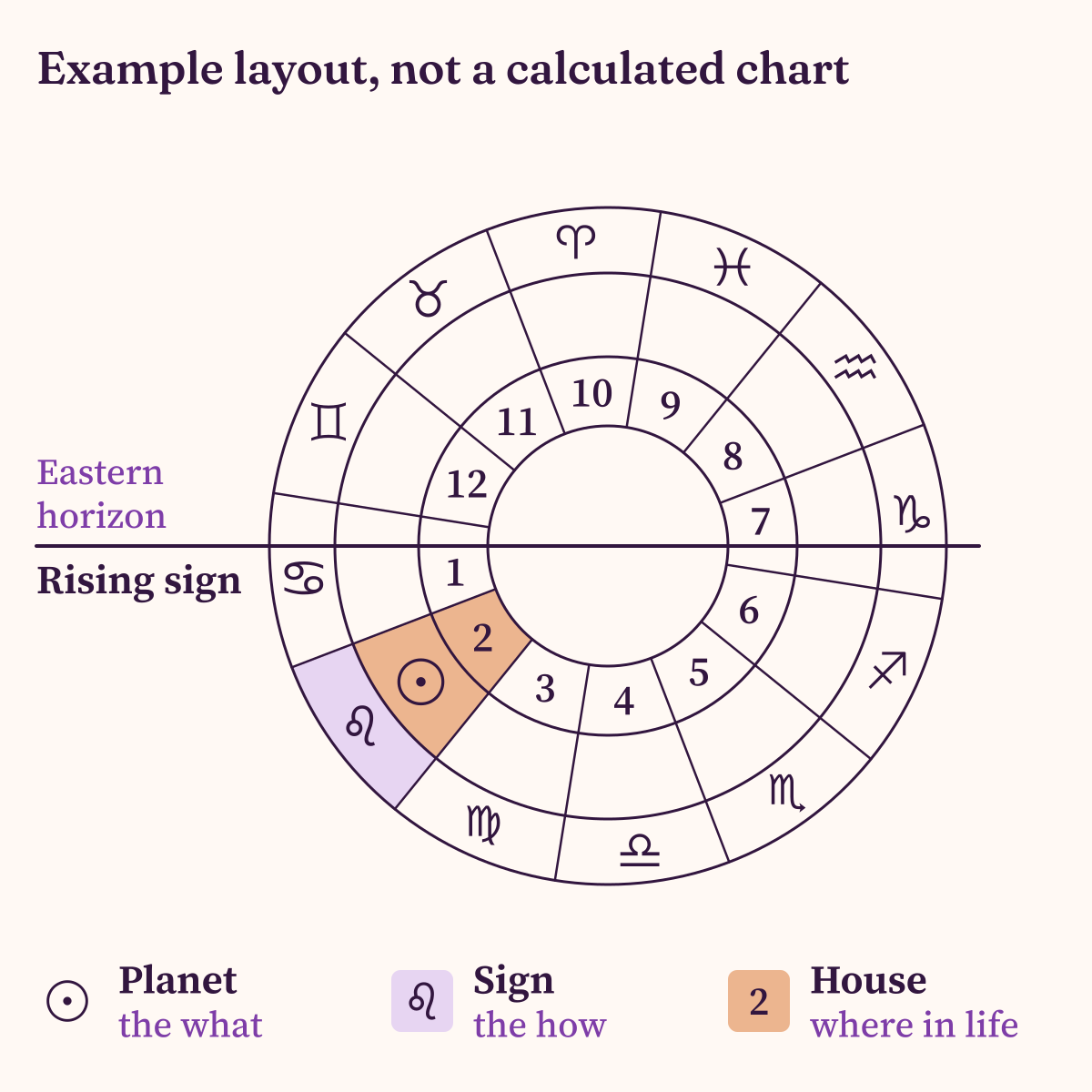
Once you get three pieces down, the chart stops being noise.
The planet (or the Sun, Moon, or rising point) is the "what." It names the part of you being described. The Sun is identity and purpose. The Moon is your emotional needs, your comfort, how you process feelings when nobody's watching. The rising sign is how you walk into a room and the first impression you leave. The other planets each handle their own job, but start with those three.
The sign is the "how." It's the style that part of you takes. Moon in Taurus means your emotional needs express themselves in a steady, comfort-loving way. You want good food, soft blankets, a predictable Tuesday. Taurus isn't just a word slapped on top of the Moon; it colors everything about that placement.
The house is the "where in life." It's the area of experience where that energy plays out. Same planet, same sign, different house, different arena. Moon in Taurus is about how you feel. Moon in the second house is about where in your life those feelings land. A sign and a house are two different layers stacked on top of each other, and neither replaces the other.
That's the whole grammar. Planet is what. Sign is how. House is where. Every other sentence in a chart reading is some variation of those three pieces talking to each other.
What you need to actually pull up your chart
Three things: your birth date, your birth time (as close to exact as you can get), and the city and state or country where you were born.
The date and time give you the positions of the Sun, Moon, and every planet. The time and place together give you the rising sign and the twelve houses.
Why the exact time matters this much: the rising sign is the zodiac sign that was climbing up the eastern horizon at the moment you were born, and Earth turns fast. The rising sign moves through all twelve signs in roughly a day, which means it shifts to a new sign about every two hours on average. Your mom saying "you were born sometime in the afternoon" is not quite enough if you want your rising sign locked in.
The Moon, by comparison, changes signs roughly every two to two and a half days. That's slower, but if you were born near the day the Moon switched signs and you don't have a time, even your Moon sign can be a little fuzzy. The Sun is the slowest of the three; it stays in a sign for about a month, so a few minutes rarely move your Sun sign. But those "a few minutes" can absolutely move your rising.
Your birth place matters too. A recorded local birth time has to be converted using the correct time zone and daylight saving rules for that place and date before the chart can be calculated. Good chart software handles that conversion for you, which is why it asks for the city, not just the time. The rising sign and house lines also depend on the latitude and longitude of where you were born.
Get the date, get the time, get the city. A chart app or calculator with any of those details will do the math.
Where to start reading yours
Don't try to read the whole wheel at once. That's how people bounce off astrology for two years and come back later, or not at all.
Start with the Big Three: Sun, Moon, rising. Read them one at a time, planet plus sign, in that order. The Sun tells you who you're becoming. The Moon tells you what you need to feel okay. The rising tells you how you meet the world before anyone gets to know the rest of you.
Read your Sun in Leo and notice what clicks and what doesn't. Then read your Moon. Then your rising. Write down one sentence for each if that helps you remember them. Once those three feel real, add Mercury. Then Venus. Then the rest. You're stacking layers, not solving a puzzle with one solution.
If you don't know your birth time, start with your Sun and your Moon. You can still learn a lot from those two. Your rising sign and your houses stay open until you track down the time, and that's fine. Don't guess your rising sign from a personality checklist; it changes too fast for that to work, and a wrong rising sign sends your house assignments spinning in the wrong direction.
One small note while you're staring at that wheel: the twelve signs in Western astrology are equal 30-degree divisions tied to the seasons. They share names with the constellations overhead, but the two aren't the same thing. Your chart is drawn in the seasonal zodiac, not the star map. You won't run into this distinction in a Big Three reading, but it can save you a moment of confusion if you ever compare your chart to the night sky.
Your chart is fixed. It's the sky at one moment, locked in. The planets keep moving after that, and those moving positions are what daily horoscopes are mostly talking about. Your birth chart is the starting point everything else gets read against, and the moving planets are the weather rolling over it.
The wheel will make more sense by the time you hit the fifth planet than it does on the first. And the Leo who hates parties finally has a word for why.