Birth Chart Basics
Astrology Symbols: How to Read the Glyphs on Your Chart
Most astrology glyphs are small drawings of what they mean, like a ram's horns or a set of scales, and this guide teaches you to read your chart's symbols.
You open your birth chart for the first time and it looks like someone sneezed on a geometry worksheet. Circles, triangles, little curls, squiggles, and numbers, all arranged in a pattern you can't crack. A friend glances over and says, "Oh, your Mars is in Scorpio," like she just read a postcard.
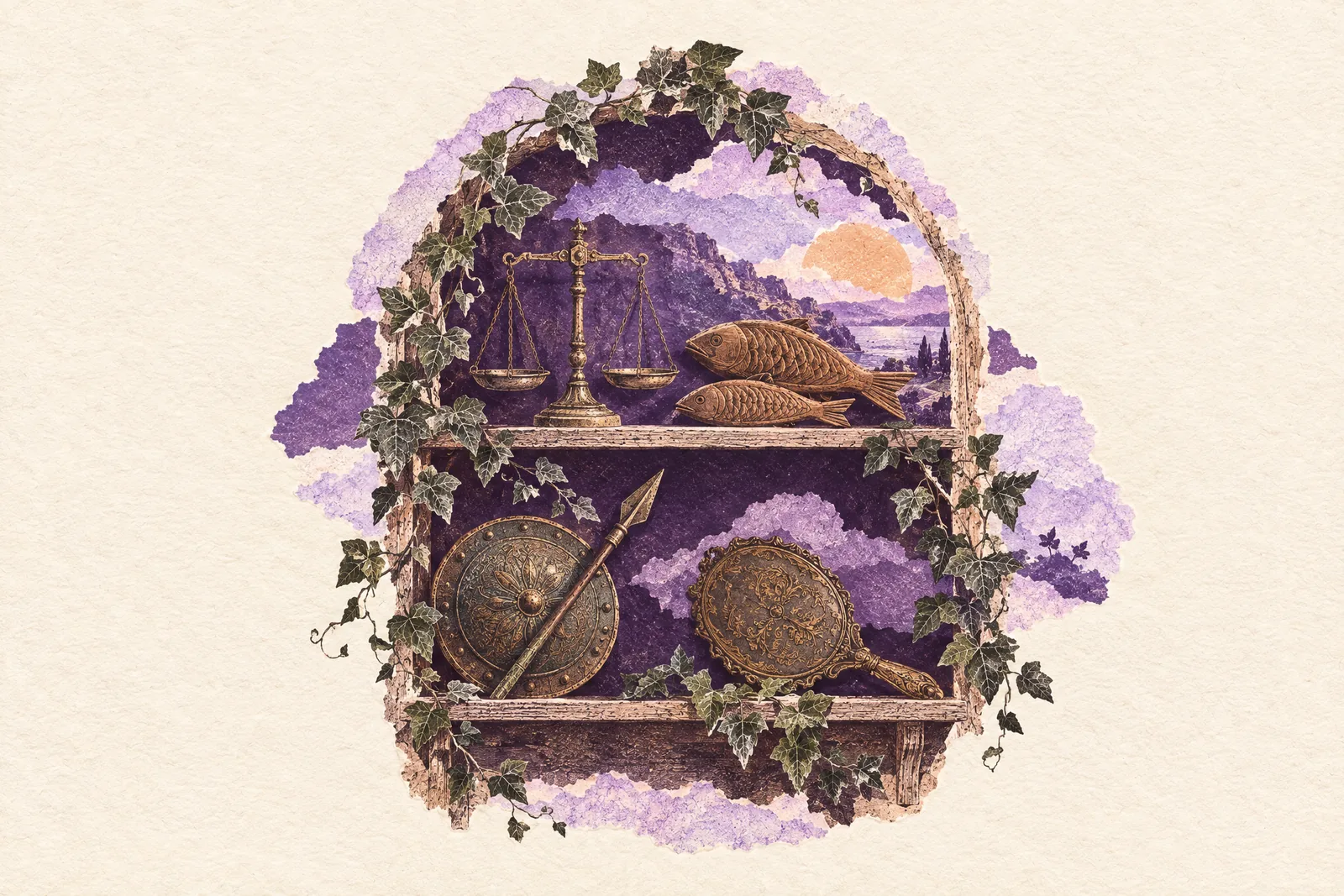
You don't need a decoder ring. Most of those symbols are tiny drawings. Aries is a ram's head. Libra is a set of scales. Venus is a hand mirror. Once you spot the picture hiding inside the glyph, the whole alphabet starts clicking. And it takes a couple of afternoons, not a lifetime.
The twelve sign glyphs
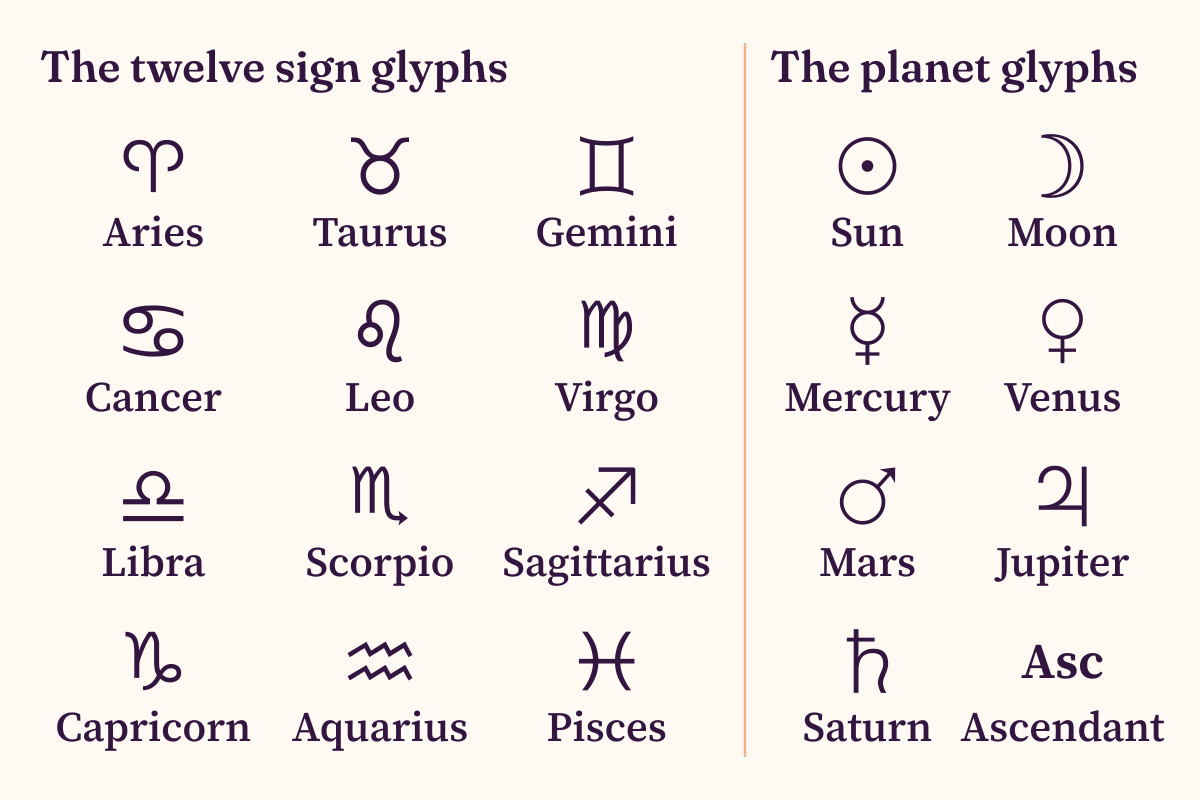
The sign symbols aren't abstract marks. They're shorthand illustrations. Most of them show exactly what the sign is named after or associated with. You just have to know where to look.
Aries ♈︎. A ram's face with two curved horns. The horns are the whole point: two curls that meet at the bottom in a V. If you see a pair of curling horns joined by a single stem, that's Aries.
Taurus ♉︎. A bull's face with horns: a circle with a wide crescent sitting on top of it. Aries is all horn and no face. Taurus has the round face, with the horns resting on it.
Gemini ♊︎. Two vertical lines connected by horizontal bars at top and bottom. That's two people standing side by side. The twins.
Cancer ♋︎. Two small curls sitting next to each other, like a backwards six and a six laid side by side. No animal picture here. Just two curves facing inward, the way the glyph looks on the page.
Leo ♌︎. A small loop that sweeps up and over into a long, curling tail. One continuous stroke, with the loop at one end and the curl at the other.
Virgo ♍︎. Think of a lowercase "m" with one extra loop at the end. That trailing curl is what separates Virgo from a regular m-shape.
Libra ♎︎. Two horizontal lines, with the top one rising into a small hump in the middle. That's the beam and pans of a weighing scale, simplified to a couple of strokes.
Scorpio ♏︎. Three humps that look a little like a lowercase "m" with the last hump dragging into a sharp upward point. That pointy tail is the stinger. It's a scorpion, simplified until only the body and tail remain.
Sagittarius ♐︎. An arrow angled up and to the right, with a short crossbar across its shaft. It's the centaur's bow and arrow, drawn mid-draw.
Capricorn ♑︎. The head and front legs of a goat, with a curve at the bottom that swings into a fish tail. Half goat, half fish, scrunched into one small symbol.
Aquarius ♒︎. Two wavy horizontal lines, one stacked on top of the other. Ripples of water. (Heads up: Aquarius is an air sign. The water is what the water carrier pours, not the element itself.)
Pisces ♓︎. Two curved arcs facing away from each other, connected by a horizontal line through the middle. Two fish, swimming apart.
If you squint at your chart and see those pictures, you'll never confuse Scorpio's stinging tail with Sagittarius's arrow again. The two wavy lines that looked like pure scribble an hour ago suddenly say Aquarius loud and clear.
The planet glyphs and where they came from
Planets get their own set of symbols, and a lot of them are also little objects. The ones you'll see most often:
Sun ☉︎. A circle with a dot in the center. Simple, direct, you already know it. This form appeared during the European Renaissance.
Moon ☽︎. A crescent. No decoding needed. If it looks like a fingernail-shaped sliver of light, that's the Moon.
Mercury ☿︎. A crescent sitting on top of a circle, with a small cross below the circle. The whole stack traces back to the caduceus, the staff the messenger god carried. Two serpents wound around a pole, shrunk down to a crescent, a circle, and a cross.
Venus ♀︎. A circle with a small cross below it. Originally it depicted a hand mirror, or in some early versions a necklace with a pendant hanging from a loop. Either way, an object held by a goddess.
Mars ♂︎. A circle with an arrow pointing up and to the right. That's a shield and a spear. The arrow shoots outward from the circle like something launched forward.
Jupiter ♃︎. A curly shape that looks a little like a number four with a flourish. It's a monogram, a letter-form mashup based on the Greek letter for Zeus.
Saturn ♄︎. A small cross on top with a curved hook hanging below it, a bit like a lowercase h with a cross. It's an abbreviation of the Greek name Cronus.
The shapes for Mercury, Venus, Jupiter, and Saturn have been traced back to forms written in late Classical Greek papyri. What you see in your chart today is the Renaissance polish on those ancient sketches. The Renaissance is also when the Sun's circle-with-dot and the current versions of these symbols settled into the forms we use now.
Where everything sits on your chart
Pull up a wheel. The twelve sign glyphs usually run around the outer ring, evenly spaced, in order starting from whatever your rising sign is. You'll find them like numbers on a clock face.
Inside the ring, the planet glyphs float in the chart. Next to each planet glyph is a small number, and that number marks the exact degree within a sign. You don't need to decode those numbers right now. You just need to recognize that ♀︎ with a 14 beside it in Libra means your Venus sits at fourteen degrees of Libra.
The rising point is labeled Asc or AC on most charts. That little mark tells you where the Ascendant sits and which sign is your rising. There are other little marks and lines on the wheel too, and you can ignore all of them while you're building your glyph vocabulary. They'll make more sense once you can name the players.
A two-afternoon way to learn them
Don't try to memorize all nineteen at once. Start with three.
Open your chart and find your Sun, Moon, and rising sign glyphs. Write each one by hand on a sticky note, right next to its name. Copy the curve of the Moon crescent, the cross-bar of your Mercury, whatever shape you're working on. Doodle them in the margin of a notebook during a long meeting. The act of drawing the glyph sticks in a way that staring at a reference chart does not.
Once those three feel automatic, add your Mercury, Venus, and Mars. Those are your personal planets, the ones most people care about first. Now you've got six symbols you can spot in jewelry, on tattoos, at the top of astrology posts. A friend's tattoo turns out to be her Sun and Moon glyphs, and you read it like a name tag instead of a mystery.
Then cover the names on a printed chart and test yourself. You'll be surprised how fast it clicks. Most people know the full set, signs and visible planets, within a few sessions of glancing at their own chart. The sign glyphs around the edge are mostly pictures. The planet glyphs in the middle are mostly objects. Once that lands, you're not reading hieroglyphics anymore. You're reading your chart.
Go pull yours up right now. Find your Sun, your Moon, and that little Asc mark. You'll know them on sight before you finish this page.