Planets and Points
The Planets in Astrology: What Each One Means in Your Chart
Every planet in your chart runs a different part of you, from the Moon's emotional needs to Saturn's discipline. Here's what each one actually does.
Every planet in your chart names one part of you and assigns it a job. The Moon handles how you feel and what makes you feel safe. Mercury handles how you think and talk. Venus handles who and what you find attractive. Mars handles how you push forward. Jupiter handles where life feels like it's expanding. Saturn handles where you put in the slow, grinding work. And so on.
The sign each planet sits in tells you how that part does its job. Mercury in Virgo explains carefully, catches the typo in your text, and reorganizes your notes three times before you feel ready to submit. Mercury in Sagittarius gives you the sweeping conclusion, skips the footnotes entirely, and talks faster than your brain can proofread. Same job. Completely different delivery.
One quick housekeeping note: astrologers call the Sun and the Moon "planets" as convenient shorthand, even though one is a star and one is, well, a moon. We're all in on the joke. Just know that when someone says "ten planets in your chart," they mean those two luminaries plus Mercury through Pluto.
Now, here's the sorting principle that makes everything click: the faster a planet moves through the signs, the more specific its placement is to you personally. The Moon switches signs roughly every two to two and a half days. Your sister, born two days after you, might have a totally different Moon sign. Pluto lingers in one sign for decades, so its sign says more about the year you were born than about you. That speed gradient is also the best reading order. Start fast, end slow.
The personal planets: Sun, Moon, Mercury, Venus, Mars
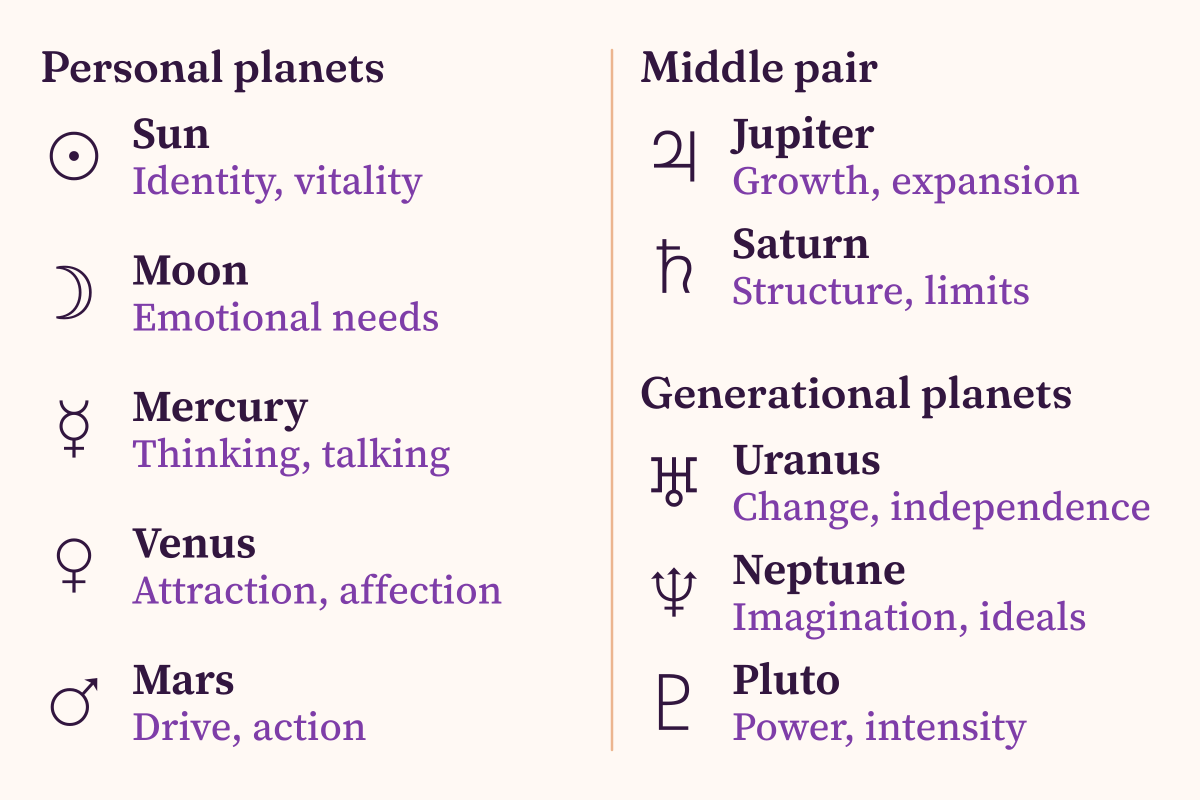
These five move fast enough that almost nobody born even a few days apart has the exact same placements. They're the ones that feel like you.
Sun: your identity, your vitality, the part of yourself you're actively growing into and showing the world. It's the conscious "this is me" energy. Not your whole personality, but the central thread.
Moon: your emotional needs, your gut reactions, the stuff you do when nobody's watching. What makes you feel safe. What you reach for at midnight. Your memory, your habits, your private inner life. If the Sun is the face you present, the Moon is what happens when you're alone on the couch with your feet up and the door locked.
Mercury: thinking, talking, learning, noticing, processing. How you text, how you argue, how you study for an exam you're cramming for, how you explain something you're passionate about to a friend who asked a simple question and now you're on minute eleven. Your sister's Mercury explains exactly why every argument with her turns into a debate about whether the facts actually support your side.
Venus: attraction, affection, pleasure, beauty, what you value. Your taste in people, in clothes, in the playlist you make for a road trip, in the way you arrange a bookshelf. It describes how you love and what you find lovely. It never, ever tells you who you'll end up with. At a party, someone asks what your Venus sign is, and for once you know.
Mars: drive, action, desire, assertion, and how you handle conflict. How you go after a goal or a person. What makes you genuinely angry. How you compete. You finally read your Mars and realize you've been micromanaging the group project because you'd rather do the task yourself than delegate it. Mars in Leo goes after things proudly, performs the whole effort, and wants credit for the win in front of witnesses.
The middle pair: Jupiter and Saturn
These two move slowly enough that large groups of people born near each other share their signs. You probably share a Jupiter sign with most of your school year, and a Saturn sign with your whole graduating class and the grades on either side of it.
Jupiter: growth, expansion, belief, generosity, meaning, and where you tend to feel optimistic. It describes where life feels bigger, where you throw doors open without checking the frame first. It's openness to opportunity, not a guaranteed lottery ticket. Jupiter in the chart says "this is the area where you say yes before you've finished the math."
Jupiter takes about twelve years to orbit the Sun, so it spends roughly one year in each sign. People born within a year of you often share it.
Saturn: structure, limits, responsibility, discipline, and time. Where you work hardest, feel most tested, and end up building the most lasting skill. It's the planet of earned things. The lesson you get by putting in the reps, not by being handed the answer. The thing people get wrong about it: Saturn isn't punishment. It's the part of your chart that says "this will take longer than you want, but you'll be genuinely good at it."
Saturn takes about 29.4 years to orbit the Sun, spending roughly two and a half years in each sign.
The generational planets: Uranus, Neptune, Pluto
These three crawl. Uranus takes about 84 years to orbit the Sun. Neptune takes about 165. Pluto takes about 248 on its long oval orbit. Each one stays in a sign for many years, sometimes over a decade.
Uranus: change, independence, innovation, disruption. The impulse to blow up what's stale and do things a new way.
Neptune: imagination, ideals, dreams, sensitivity, blurred boundaries. The pull toward something beautiful and hard to name.
Pluto: power, intensity, transformation, endings that clear the ground for fresh starts. Not a death sentence. More like the part of a generation that keeps rebuilding from the foundation up.
Because these signs span so many years, you and everyone born in the same window share them. You and your whole friend group turn out to have the same Pluto sign, which is less of a coincidence than it sounds. Your generation inherited that flavor together. What makes those outer planets personal to you specifically is how they interact with the rest of your chart, and that's a story for another day. For now, treat their signs as generational context and let the faster planets carry your personal color.
Why Mercury and Venus always stay close to your Sun
There's a shortcut worth knowing before you pull up a chart: Mercury is always in your Sun's sign, or the one right next to it. Venus is always within two signs of your Sun. They hug the Sun's position in the sky, which is why their signs are always close to your Sun sign.
What this means practically: your Mercury sign is almost always your Sun sign or an adjacent one. If you're a Gemini Sun, your Mercury is a Gemini, Cancer, or Taurus. Not a Pisces. Not an Aries. So if someone says "Mercury in Scorpio" and you're a Cancer Sun, that's not your chart. Quick check, no app required.
Venus behaves the same way within a slightly wider window. You can't be a Sagittarius Sun with Venus in Virgo. Something's off in the data.
Where to start with your own chart
You already know your Sun, Moon, and rising. That's the Big Three, and it's a solid foundation. The next three you want are Mercury, Venus, and Mars. They move fast, they're personal to you, and they answer the "so how do I actually operate day to day?" question: how I think, how I love, how I chase.
Grab your birth date, time, and place, pull up a free chart calculator, and scan those three signs. You'll have the full sentence, not just the headline, for the parts of yourself you spend the most time navigating. That's the next layer down from the Big Three, and it's where the reading starts getting really specific to who you are.