Birth Chart Basics
The Myths Behind the 12 Zodiac Signs
Behind every zodiac sign is a constellation, and behind each one a Greek or Roman story, from a golden ram's rescue to a crab that took on Heracles.
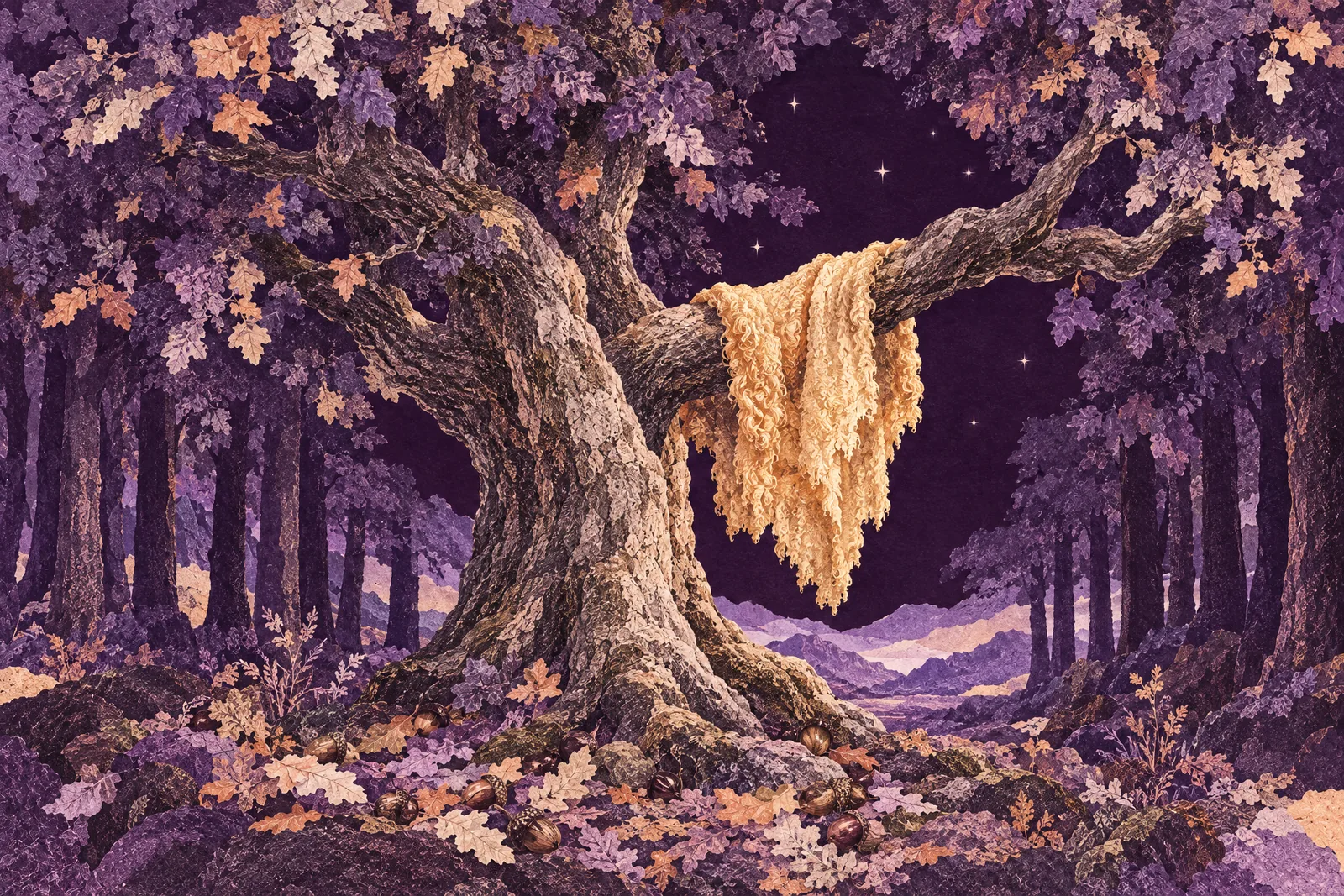
You've worn a little gold ram pendant for two years, the kind you picked up at a museum gift shop because it looked cool. You probably never thought past "it's cute." And then one rainy afternoon you go looking up the myth of Aries, expecting some vague tale about a brave animal, and you find out it's a rescue. A cloud nymph sent that ram to pull two children away from sacrifice. One of them fell into the sea. The other reached safety, and the ram's golden fleece hung in a sacred grove until another hero, Jason, sailed across the world for it. The pendant on your chest is a getaway car. Every sign works like that. Behind each glyph is a constellation, and behind each constellation, if you go looking, is a story the Greeks and Romans hung in the sky like a plaque at a battlefield.
Where the zodiac's stories come from
To the Greeks, a constellation was a memorial. A hero or a creature got placed among the stars because of something it did, and poets told those stories in verse. Most of that verse is gone. What survived came through later handbooks, above all Pseudo-Eratosthenes, Aratus, and the Roman mythographer Hyginus, who compiled and paraphrased what came before them. [1]
And the figures themselves are older than any Greek story draped on them. Mesopotamian astronomers already had a Bull of Heaven, the Great Twins, a Lion, the Scorpion, the Scales, and a Goat-Fish plotted in their sky, and they called the stars of Aries the Hired Man. [1:1] The Greeks looked at those same dots and said, "Yes, but what happened there?" That's the move. The sky was already drawn. The myth is the caption.
 Aries: the golden ram
The cloud nymph Nephele sent a flying, golden-fleeced ram to carry her children, Phrixus and Helle, away from a sacrifice they couldn't talk their way out of. It bore them over the sea. Helle lost her grip and fell into the strait that still carries her name, the Hellespont. Phrixus reached Colchis, where the ram was offered up and its fleece hung in a sacred grove: the Golden Fleece Jason later sailed for. Eratosthenes tells a gentler ending. The ram took off its own fleece, pressed it into Phrixus's hands as a keepsake, and rose to the stars under its own power, which is why the constellation shines so faintly. [2]
Notice the first sign of the zodiac opens with someone already in motion, already committed to getting out of a bad spot. Cardinal fire doesn't deliberate. It goes.
 Taurus: the bull at the shore
Zeus came to the Phoenician princess Europa as a bull while she played at the waterline, coaxed her onto his back, and carried her across the sea to Crete. The Greeks would not have called this a romance. It's an abduction, dressed in fur. Another version says the constellation marks Io, a princess Zeus turned into a heifer to hide her from Hera's jealousy. Also not romantic. Also a transformation imposed on someone else. [1:2]
The plot drops away, and what's left is the animal itself. Solid, broad-shouldered, standing at the tide line and refusing to budge until it decides to move. Fixed earth, in a single image.
 Gemini: the twins who shared everything
The twins are Castor and Pollux, famous horsemen who helped sailors in trouble. Hyginus says they were the most affectionate of brothers, and that Zeus set them among the stars specifically for their friendship. In a version he credits to Homer, Pollux gave his brother half his own life, so the two shine on alternate days. Some writers swapped in Apollo and Heracles instead. Either way, the image is two people whose whole identity is partnership and exchange.
A sign built on conversation, curiosity, and swapping ideas gets two brothers who never did a thing without talking it through first.
 Cancer: the crab that took on Heracles
While Heracles hacked at the many-headed Hydra in the swamp at Lerna, a crab crawled out of the mud and snapped at his foot. He crushed it under his heel. Hera thought it deserved better, so she put it in the sky. Two stars on the crab's back were said to be the Asses, the donkeys of Dionysus. [1:3]
Cancer is cardinal water, the sign that starts protecting people the moment it senses a threat. Its emblem is small, armored, and loyal enough to take a swing at a hero on behalf of its own side.
 Leo: the Nemean lion
The lion of Nemea had a hide that no blade, no arrow, no spear could mark. Killing it was the first of Heracles' twelve labors, and he did it unarmed, strangling the thing with his bare hands. Hyginus gives an even simpler reason for the lion's place in the sky: it is the king of beasts, and that's enough.
That might be the most Leo line in the whole collection. No special mission. No secret wound. The lion is up there for the sheer fact of being the lion.
 Virgo: the last immortal to leave
The maiden is most often Astraea, called Justice, daughter of Zeus and Themis in Hesiod's telling, or of Astraeus and Eos in Aratus. She walked among people through the Golden Age, held them to a standard, and withdrew step by step as they grew greedy and warlike. She was the last of the immortals to leave the earth, lifting off into the stars when there was nothing left to fix. Other names for the maiden include Demeter, Tyche, and Erigone.
A goddess who watched people fail to meet a standard and was still the last one to turn her back on them. It makes a fair portrait of a sign read through discernment and quiet, exacting care.
 Libra: scales, claws, and scales again
Libra is the only object in the zodiac, a thing instead of a creature or a person, and its history shows it. Greek writers often looked at those stars and called them the claws of the neighboring scorpion. Hyginus writes that the Scorpion is divided into two parts on account of the great spread of its claws, and that Roman writers called one of those parts the Balance. Other accounts hang the scales beside Astraea in Virgo, as her scales of justice. And the Mesopotamians, who got there first, already called those stars the Scales. [3]
So the sign built on balance, negotiation, and weighing one side against the other spent centuries being weighed itself. Claws or scales, depending on which culture was looking. The scales won. Your Libra friend is going to be delighted to learn her sign used to be scorpion claws, and that she can bring that up at parties forever.
 Scorpio: the scorpion and the hunter
Orion, the greatest hunter of his age, boasted he could kill anything the earth produced. The earth sent a scorpion, and it killed him. Zeus placed them in the sky at Artemis's request in positions so opposed that as the Scorpion rises, Orion sets. They never share the sky. Hyginus frames it as a lesson about not being too self-confident. Other tellings have Artemis kill Orion herself. [3:1]
Intensity, a long memory, and an arrangement where two old rivals will never be in the same room. You look up on a clear summer night, find the Scorpion low in the south, and Orion is simply nowhere to be seen. The story is still running overhead, in real time.
 Sagittarius: two archers
The popular answer, the one on every zodiac poster, is Chiron: the wisest of the centaurs, who raised the hero Achilles and the healer Asclepius, and who gave up his own immortality after one of Heracles' poisoned arrows landed on his foot. Some ancient writers put him in Sagittarius. Hyginus does not. He places Chiron in a separate constellation, Centaurus. [4]
For the archer, Hyginus tells of Crotus, son of Eupheme, the nurse of the Muses. Crotus lived on Mount Helicon with them, went hunting, and was known for being swift in the woods and clever in the arts. At the Muses' request, Zeus set him among the stars with a horse's flanks for his riding, arrows for his keenness and speed, and a satyr's tail, with a little circle of stars at his feet like a wreath tossed off in play. [5]
You've been telling people Sagittarius is Chiron for years. Now you have a second archer and a better story. Both suit a sign that loves to explore and believes things wholeheartedly: one taught heroes and healers, the other spent his whole life among poetry and the hunt.
 Capricorn: the goat that dove into the river
When the monster Typhon crashed into Egypt where the gods were gathered, they panicked and hid in animal shapes. Pan threw himself into the river, and the part of him underwater became a fish while the rest stayed goat. Zeus thought that was quick thinking, and put the likeness in the sky. Eratosthenes gives a variant: Aegipan, raised alongside Zeus, hurled shellfish into the ranks of the Titans during their war, scattering them with panic, and his fish tail is the reminder of those shells. The goat-fish figure itself predates both stories.
Half goat, half fish, saved by a split-second decision in a crisis. A practical, resourceful sign couldn't ask for a better mascot.
 Aquarius: the cupbearer and the flood
The water-pourer is most often Ganymede, a Trojan prince carried off by Zeus's eagle, the neighboring constellation Aquila, and set to pour the cup for the gods on Olympus. He's shown tilting an urn over the edge of the sky. Others named the figure Deucalion, survivor of the great flood, or Cecrops, an early king of Athens said to be the first to pour offerings to the gods.
Aquarius belongs to air, ideas, and shared causes, but its figure always carries water. It's always pouring out for others. That tension, an air sign whose whole visual is a fluid act of service, is part of what makes the sign feel odd and generous at the same time.
 Pisces: the fish in the Euphrates
Hyginus, citing Diognetus of Erythrae, says Aphrodite and her son Eros were standing by the river Euphrates in Syria when Typhon appeared. They threw themselves into the water and changed into fish to escape. In Ovid's telling, two fish carried them to safety instead. [6]
For a sign read through imagination, empathy, and the ability to become something else when the walls close in, the escape comes by changing shape and slipping under. Two different zodiac posters can give your sign two different stories, the transformation and the rescue, and both are genuinely there in the sources.
The myths are the pictures, not the meanings
One distinction keeps all of this from getting tangled. A zodiac sign and the constellation it's named after are not the same thing. The sign is a thirty-degree slice of the Sun's yearly path through the sky, and its meaning comes from element and modality. Aries is cardinal fire. Scorpio is fixed water. The myth belongs to the constellation, which is a separate drawing in the sky that happens to share a name. The stories were never a personality system. They're pictures hung next to the signs, and some of them rhyme with how the sign is read, and some of them don't rhyme at all. That's what makes them fun to notice rather than a test to pass.
Go look up
Pick a night about six months from now, around your half-birthday, when your sign's constellation isn't lost in the Sun's glare but sits well placed in the evening sky. Step outside, find those stars, and tell yourself the story while you look at them. A golden ram carrying children over the sea. A crab snapping at a hero's ankle. A goddess who was the last immortal to leave, climbing into the dark. The pendant on your neck, the tattoo on your wrist, the sign on your phone wallpaper: they all came from somewhere. Now you know where.
Theoi Project, Star Myths (Constellations), introduction and constellation entries. ↩︎ ↩︎ ↩︎ ↩︎
Theoi Project, Chrysomallus, Golden-Fleeced Ram, quoting Pseudo-Hyginus, Astronomica 2.20. ↩︎
Theoi Project, Scorpius, Giant Scorpion, quoting Pseudo-Hyginus, Astronomica 2.26. ↩︎ ↩︎
Theoi Project, Chiron, Elder Centaur, quoting Pseudo-Hyginus, Astronomica 2.38. ↩︎
Theoi Project, Crotus, Boeotian Satyr, quoting Pseudo-Hyginus, Astronomica 2.27. ↩︎
Theoi Project, Ichthyes, Fish of Aphrodite, quoting Pseudo-Hyginus, Astronomica 2.30, and Ovid, Fasti 2.458. ↩︎