Zodiac Guides
Which Greek God or Goddess Is Your Zodiac Sign?
Each zodiac sign gets the Greek god or goddess whose best-known myth acts out its element and modality, earned by a story, never by a planet's name.
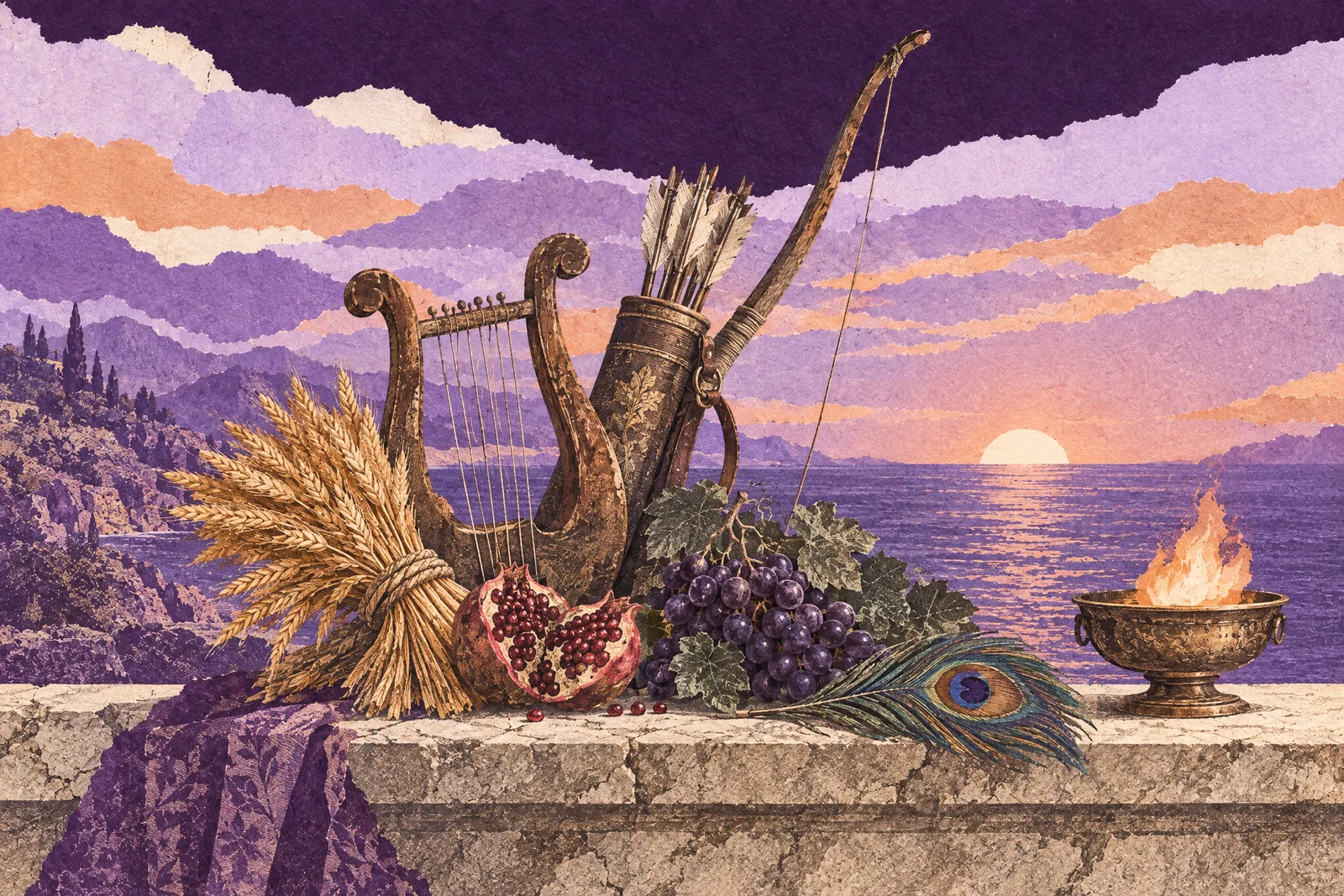
Picture a small kid climbing up onto her father's knee and asking, point by point, for a bow, arrows, a hunting tunic, a pack of friends, and every mountain on the map. Zeus smiles, says yes to all of it, and throws in thirty cities as a bonus.[1] That is the most Aries moment in all of Greek myth, and it belongs to Artemis, not Ares. The charts that match Aries to Ares or Gemini to Hermes are borrowing a planet's name. They skip the story, which is the whole fun.
So here is the rule: each sign gets the god or goddess whose best-known myth acts out that sign's element and modality. What does the plot turn on? Action and nerve (fire), the harvest and things built to last (earth), words and judgment (air), or home, depth, and dreams (water)? And what does the deity do inside it? Set the story in motion (cardinal), dig in and refuse to budge (fixed), or keep changing roles and locations (mutable)? One deity per sign, earned by a myth, never by a name on a planet.
Opposite signs sit six places apart on the wheel and always share a modality. Aries and Libra are both cardinal. Taurus and Scorpio are both fixed. Gemini and Sagittarius are both mutable. Cancer and Capricorn are both cardinal. Leo and Aquarius are both fixed. Virgo and Pisces are both mutable. That means each pair shows one pace in two different elements: two starters, two holders, two movers. The deities line up with that pattern neatly, and one pair (you will meet them below) turns out to share a single myth.
 Aries and Libra: Artemis and Athena
Artemis is the kid who knows what she wants before she can tie her own sandals. Callimachus has her on Zeus's knee as a child, listing demands: stay unmarried forever, give me a bow, give me nymphs, give me the mountains. Zeus grants it all, and she grows up to be the goddess of hunting, wilderness, and wild animals, living the life she negotiated as a kid.[1:1] Aries cardinal fire means the impulse to go first, plainly, and then keep running into open country. You negotiated salary in the first interview and booked the solo hiking trip the same week. You are Artemis, and nobody handed you that plan.
Athena starts things too, but between people, and she cares whether the terms are fair. This is cardinal air at work. Athena's two great stories are both about building something a whole city can share. In the contest for Athens, Poseidon struck the Acropolis and a sea spring gushed out. Athena planted an olive tree. The twelve gods judging the contest gave her the city because Cecrops testified she had planted first (Apollodorus's version). Her gift feeds people for generations; his was a spectacle. In Aeschylus's Eumenides, Athena sets up a court of citizens on the Areopagus to try Orestes, breaks the tied vote with the casting vote, and then talks the Furies into accepting an honored home in Athens. She starts institutions. You walk into a roommate standoff over dishes and leave with a rotation everyone can live with. Your growing edge: you can bring anyone to the table and still end up doing all the diplomacy yourself.
Both signs are cardinal, both starters. Artemis starts alone and runs for the hills. Athena starts something the whole city can sit down around.
 Taurus and Scorpio: Demeter and Persephone
Demeter is the goddess of agriculture, grain, and bread: the full table, the fed household, the smell of warm loaves in a kitchen at dusk. Her famous story is a masterclass in staying power, the fixed-earth refusal to negotiate past her own answer. When her daughter was taken, she made a year in which the earth sprouted no seed anywhere, and she rejected the gifts and pleas of the gods who came to her one after another, until she saw her daughter again.[2] She names one condition and simply does not move. Every offer, every compromise, every "but think of the farmers" bounces off. Gift: generosity that shows up as food and comfort. Edge: once she has decided, even a good deal hits a wall.
Persephone is Demeter's daughter and also her own authority. Taken to the underworld, she became its queen, a goddess at home in a realm the other gods avoid. Hades gave her pomegranate seed to eat before she left, so the Homeric Hymn says she spends a third of every year below; later writers say half. She is also a goddess of spring growth, so she knows the dark and the return equally well. Scorpio fixed water: feelings that run deep, kept private, held for years, and a comfort with subjects other people flinch from. You ask the question everyone else at the table was avoiding, calmly, and then actually listen to the answer. People find you formidable because you meet them on your own ground.
These two turn out to be the same myth. Demeter holds out above ground. Persephone holds a kingdom below. The seasons turn between the two of them, and fixed energy splits into two elements. Stubbornness as harvest. Stubbornness as depth. You do not have to pick a side; the pair holds both.
 Gemini and Sagittarius: Apollo and Dionysus
Someone asks what you do for a living, and your answer takes three sentences and ends with a hobby that is becoming a fourth. Welcome to mutable air.
Apollo has one of the longest job descriptions on Olympus: prophecy and oracles, music, song and poetry, archery, medicine. He is also a twin, the brother of Artemis. His oracle at Delphi was the most famous place in Greece to bring a question. Herodotus tells how King Croesus of Lydia asked whether he should attack Persia and was told he would destroy a great empire. It was his own. The story is probably legendary.[3] Gemini loves a sentence with two readings, a life with several careers running at once, and a question that does not resolve neatly. You adapt by collecting skills and trading ideas, and you never pick the one lane anyone expected.
Dionysus adapts by moving. He is the god of wine and festivity, and Greek drama grew out of the choruses at his festivals, which makes him the protector of theaters. The myths send him wandering through Egypt and Syria, through Thrace, and all the way to India, bringing the vine and insisting on being recognized wherever he lands. In the Homeric Hymn, pirates grab him because they think he is a prince worth a ransom. Wine streams across the deck. A vine spreads along the sail. He becomes a lion. The sailors leap overboard and become dolphins, except the helmsman, whom he spares. Sagittarius is mutable fire: you arrive from somewhere far away, absolutely sure of who you are, and turn an ordinary night into a story people retell for years. The wine only opens the evening; the wide-angle view is what you came for.
Both are mutable, and neither settles. Apollo adapts through skills and questions. Dionysus adapts through roads and parties.
 Cancer and Capricorn: Hestia and Zeus
Two weeks after you move to a new city, your apartment is where everyone ends up after dinner. Cardinal water builds belonging from scratch, wherever it lands.
Hestia is the goddess of the hearth, both the home's fire and the city's public fire. The Homeric Hymn says mortals hold no feast where wine is not poured to Hestia first and last. The detail that makes her Cancer is a custom: when a Greek colony was founded, the settlers took fire from the hearth of the mother city to light the hearth of their new home.[4] Home, carried along and started again. Cardinal means she begins the place where people belong wherever she lands. She was also the first child Cronus swallowed and the last he brought back up, so she was called both the eldest and the youngest. She swore to remain a maiden, which is the same energy as "I am the home, and I do not need a husband to be one."
Zeus begins as a hidden baby. His mother Rhea hid the newborn in Crete and handed Cronus a stone wrapped in swaddling clothes. He grew up, freed his swallowed siblings, and fought a war against the Titans that Hesiod says lasted ten full years. After the victory, Zeus, Poseidon, and Hades drew lots for the sky, the sea, and the underworld. Zeus took the heavens and the unglamorous follow-up: running Olympus. That is Capricorn cardinal earth, starting structures and then carrying them for years: patient buildup, long campaign, then the responsibility of keeping the whole thing standing. You joined a committee and somehow run it now.
Hestia and Zeus are sister and brother, and each begins something different: she starts homes, he starts a government.
 Leo and Aquarius: Hera and Prometheus
You walk into a wedding and the room rearranges itself around you. You also remember exactly who did not RSVP, and you will bring it up, gently, in August. Fixed fire warmth that holds steady and expects to be seen.
Hera is queen of the gods and goddess of marriage, and she carries herself like it. She expects to be honored as queen, takes her vows seriously, and her loyalty holds for eternity. Her bird is the peacock, and Ovid (a Roman poet) tells how she set the hundred eyes of Argus among its feathers, which is the most Leo piece of interior decorating in mythology: I want everyone to see that I see everything, and it looks gorgeous. Pride that will not let a slight slide, affection that runs to the end of time, a temper you acknowledge with a knowing wink.
Aquarius fixed air is the stubborn idealist: once something looks right for everyone, it stays decided. Prometheus is a Titan (one of the older generation, so nobody should be surprised he is not an Olympian) whose name means forethought. He stole fire in a hollow fennel stalk and gave it to humankind, and he was chained to a mountain for it until Heracles set him free. The idea came first, and it was done for everyone. He held his position under enormous pressure. You argue for the unpopular change at work because it helps the people who are not in the room.
Both fixed. Hera holds her throne. Prometheus holds his ground against the throne. The same staying power pointed at the crown and at the crowd.
 Virgo and Pisces: Hephaestus and Morpheus
You rebuilt the shared spreadsheet so it finally works, and you never mentioned it. Mutable earth, the discerning eye and the useful pair of hands.
Hephaestus is the god of fire, smiths, craftsmen, metalworking, and sculpture, the one Olympian who works with his hands. Homer describes the houses he built for the gods on Olympus and the golden handmaidens with thought and speech who helped him. At Thetis's request he made the armor of Achilles. Everything he produced was useful and exact, and he did the work the flashier gods took credit for. Skill in service, a perfectionist's eye, quiet pride in things that actually function. Edge: the craftsperson gets less credit than the people standing in the palace.
Pisces mutable water is the opposite move: you can do a perfect impression of your new manager after one meeting, voice and all, and your dreams come with plot twists. Morpheus is the son of Sleep, best at taking human shape in dreams, copying a person's features, walk, speech, clothes, and turns of phrase so precisely that the dreamer believes it is him.[5] In Ovid, this dream god is the shapeshifter of sleep, the one who can be anyone. Gift: empathy so accurate it is almost physical. Edge: losing track of your own shape after playing everyone else's.
Across the wheel from each other sit two makers. Hephaestus makes things you can hold. Morpheus makes things you can only see with your eyes closed.
Which story do you actually tell?
The match is built on the Sun sign, which is about identity and conscious self-expression. The deities here are characters from stories, and the fun is in the fit. Hestia's fire, carried out of one city to light the hearth of the next: that is the whole gesture of finding a match. You take something old and warm and set it down in a new place where it belongs.
So pick the one story of your deity you would actually retell over dinner. It doesn't have to be the famous one, just the one that makes you say "oh, that's me" before you even finish the sentence. Then go read the god or goddess on the opposite side of the wheel. Same pace, different element. You might recognize the speed and not the setting, and that gap is where the interesting conversation lives.
Theoi Greek Mythology, Callimachus, Hymns, Hymn 3, To Artemis. ↩︎ ↩︎
Theoi Greek Mythology, Homeric Hymn 2, To Demeter, lines 301-334 and 370-404. ↩︎
Wikipedia, Croesus, section on the Delphic oracle (after Herodotus, Histories 1.53). ↩︎
Theoi Greek Mythology, Hestia, section on the public hearth and colonies. ↩︎
Theoi Greek Mythology, Oneiroi, Morpheus in Ovid, Metamorphoses 11. ↩︎