Houses
The 12 Houses in Astrology, Explained
The twelve houses show where in your life a planet's energy actually plays out, from money and home to career and friendship.

You type in your birth details, the little chart pops up, and there it is: "Venus in Leo in the 5th house." The Leo part makes sense. You get warmth, drama, a good entrance. The 5th house part makes you stare at the screen like it's written in a dead language.
Here's what's actually happening. Your chart divides into twelve zones, and those zones are ordinary life: money, siblings, your apartment, dating, your nine-to-five, your friend group. The twelve houses are the map of where you live, laid over the sky. Once you know them, a placement stops floating in the abstract and lands in a specific corner of your week.
Think of it this way. A planet is the what: which part of you is turned on. Venus means love, beauty, pleasure, what you're drawn to. A sign is the style: Leo does love like a spotlight performance, Virgo does love like a thoughtfully stocked kitchen. A house is the where in life it plays out. So Venus in Leo in the 10th house says your big, warm, slightly theatrical way of loving shows up in your career and public reputation. You're the coworker who makes the whole office feel like a premiere screening. Same Venus, same Leo, but drop her into the 4th house and all the energy goes into how you decorate your living room and host the family dinner everyone looks forward to.
That's the houses. Twelve areas. Every planet in your chart sits in one of them, and suddenly the placement has a zip code.
Why your birth time matters here
You can look up your Sun sign from your birthday alone. The houses don't work that way. They need the time you were born and the city you were born in, because the houses rotate through the zodiac as the Earth spins. A rising sign changes roughly every two hours, and the houses shift with it.
Type in a time that's off by an hour or two, and your rising sign can change, which slides every house in your chart to a different sign. Your whole map moves. If you don't have an exact time, the houses stay in the fog, and that's okay. Plenty of people work with their Sun, Moon, and rising and call it a day.
For house readings, we use whole sign houses. Your rising sign is your entire 1st house. The next sign in zodiac order is the 2nd. Then the 3rd, and so on, one sign per house, all the way around. So if you're a Virgo rising, Libra is your 2nd house, Scorpio is your 3rd, and Pisces is your 7th. Any planet parked in Libra sits squarely in your 2nd house, no measuring required.
Many chart apps default to a different system called Placidus, which divides the chart unevenly. That means the same planet can show up in the 2nd house on one app and the 3rd on another, and both screenshots are technically right. If the two systems disagree about a planet, read both house sections. Neither one is "wrong." They're just different ways of drawing the grid.
Houses 1 through 4: you and your foundations
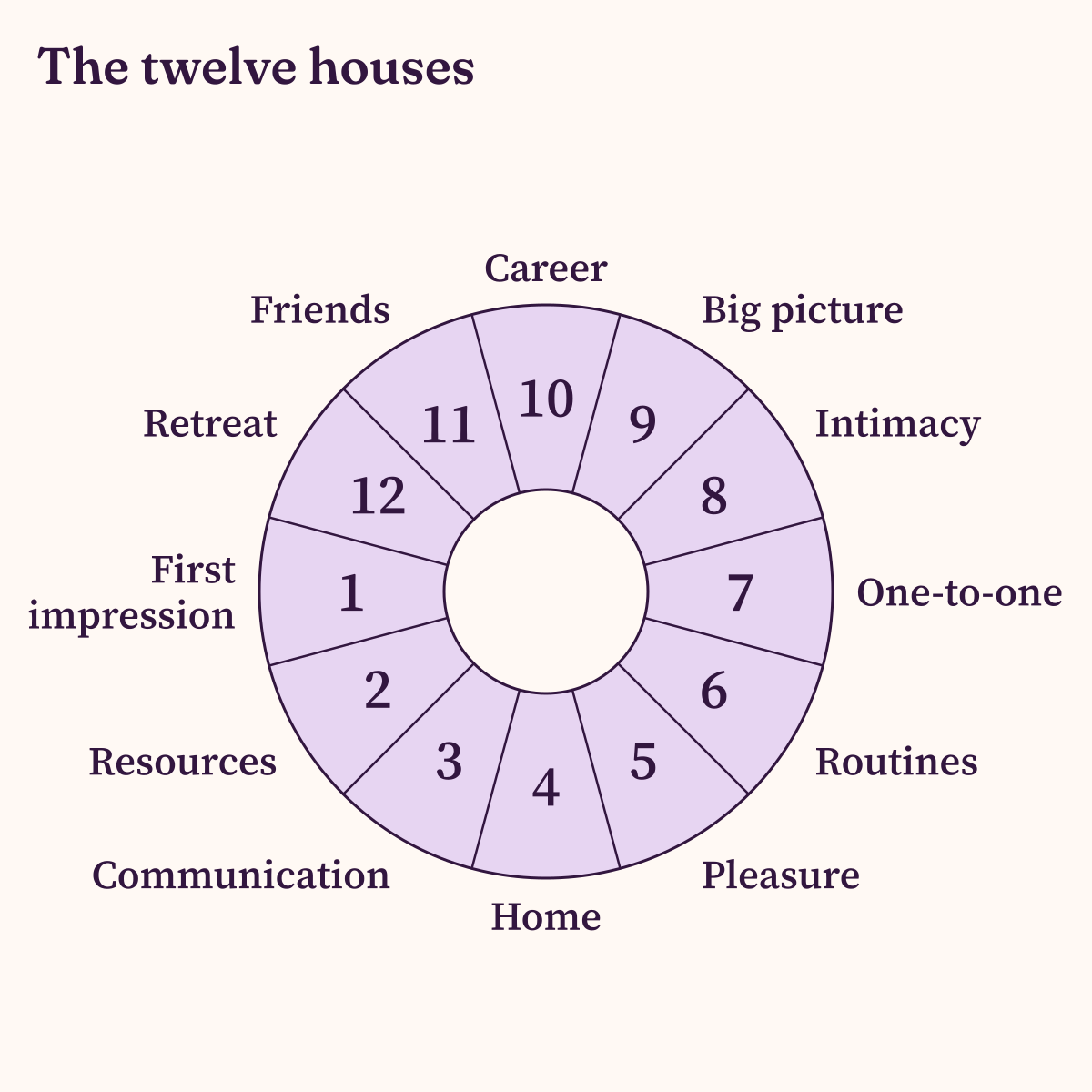
1st house. This is the whole front door. Your body, your first impression, the energy you walk into a room with, how you start things. It's the lens you see the world through before the world even has a chance to talk back. If the Sun lands in your 1st house, you're the one who walks into a new friend group and immediately becomes the person everyone else gravitates toward. You don't plan it. You just arrive.
2nd house. Your resources. The money that's actually yours, the stuff on your shelf, the routines that make you feel stable enough to breathe. At work, this is where you look for what you earn from and what you value. You're the person who keeps a spreadsheet of every subscription you've forgotten to cancel, not because you're cheap, but because the mess of unclaimed money makes you feel untethered. Your 2nd house fills when you notice what you actually want versus what you grabbed because it was on sale.
3rd house. Communication, learning, siblings, neighbors, the ten-minute walk to the bodega that counts as your "going out." Work angle: anything that involves writing, teaching, or running a social media account lives here. If Mercury sits in your 3rd house, you text your sister three times a day about nothing in particular, and you've started four separate newsletters "just to see." You think out loud. You process by talking. A long car ride to visit your parents becomes a four-hour podcast about your childhood.
4th house. Home. Not the square footage, but the feeling of coming back. Your roots, your family patterns, the private life nobody else gets a tour of. This is the house that asks: when the noise finally stops, where do you set down the weight? You might not clock it until you move into your first apartment alone and realize you've rearranged the bookshelf six times trying to make it feel like the living room you grew up in.
Houses 5 through 8: creativity and connection
5th house. Pleasure with a capital P. Creativity, romance, play, hobbies, the part of you that performs for fun. This is karaoke on a Thursday night. This is the painting you never show anyone. At work, if your job lets you make something new and show it off, that's 5th house work. Your 5th house lights up when you do something purely because it's joyful, not because it's productive.
6th house. The care and feeding of your daily existence. Routines, work habits, how you keep the machine running: laundry, groceries, the coworker who reminds you the printer is out of toner. It's the least glamorous house in the chart, and it holds everything else up. Your 6th house is where you build the small structures that keep an ordinary week from falling apart. The work angle here is the actual job: the task list, the coworkers, the daily collaboration. You maintain. You service. You make things work so the rest of the chart can do its flashier stuff.
7th house. One-to-one. The business partner, the spouse, the therapist, the rival who will not let you walk past without a comment. Contracts. Any relationship that isn't you-by-yourself or you-in-a-crowd. If your 7th house is loaded, you do your best thinking across a table from another person. You need the mirror. If it's empty, that just means the chart doesn't spotlight that area. It still exists in your life.
8th house. What you share with another person. Joint bank accounts, vulnerability, the merging that happens when two lives tangle. Intimacy in the literal and figurative sense: letting someone see the part you keep in a drawer. Transformation, too, the slow shedding of a version of yourself you've outgrown. This is the house where you stop performing and start trusting. At work, it's the shared budget, the merger, the project where your success is locked to someone else's.
Houses 9 through 12: bigger horizons and community
9th house. The big picture. Higher education, philosophy, long-haul travel, publishing, the questions that keep you up at 2 a.m. because you need to understand the why behind the rules you've been handed. At work: teaching a seminar, writing the long-form piece, booking the trip that expands the brand into a new market. Your 9th house hums when you're learning something that changes how you see everything underneath it. A single foreign film can reroute your entire worldview.
10th house. The top of the chart. Career, reputation, the thing people point to when they say "oh, that's the one who..." This is visibility. Authority. The version of your work the world can see from a distance. You might not feel ambitious on the inside, but if a planet lands here, your work tends to be where people notice you. You build, people see it, and you wonder why they're applauding when you were just doing your thing.
11th house. Your people. Not one person, the whole constellation: friends, networks, the group chat that has existed since 2017, the collective you're building toward. Hopes for the future, the kind you can't yet name but can feel pulling you forward. If your 11th house is busy, you think in teams. You process your identity partly through who you surround yourself with. The goal isn't the solo achievement. It's the thing that exists because a bunch of people decided together to make it real.
12th house. Retreat. Solitude. The hidden, private, unperformed layer of you. Spirituality, rest, the work that happens where no one sees. This is never a bad house, never a curse, never a warning sign. It's the room you go to recharge when the other eleven houses have been loud. At work, it's behind-the-scenes roles, caregiving, the editing that shapes a project without a byline. If Neptune or the Moon sits here, you need actual solitude, not a night out pretending to rest. You process in silence, and that's not antisocial. That's your rhythm.
What an empty house means
There are ten planets and twelve houses. Some houses are empty in every chart, always, for every person. That's math, not fate. An empty house is still a room in your life. You still have money, siblings, a career, a friend group. The chart simply doesn't put the spotlight on that particular room. No planets means no built-in emphasis, no recurring theme the universe keeps nudging you toward. If your 7th house is empty and you briefly spiraled about being alone forever, an empty house isn't the reason. It's an empty stage, not a locked door. You walk on when you want to, and the lack of built-in drama in that area can actually be a relief. No one's handing you a recurring lesson. You get to decide what you want there, free and clear.
Your 1st house isn't Aries
One distinction worth its own section: your 1st house isn't Aries, your 2nd house isn't Taurus, and your 7th house isn't Libra. Aries shares some flavor with the 1st house in certain teaching traditions, but they're separate layers. A Moon in Aries and a Moon in the 1st house are two different placements that read differently. Signs describe a style. Houses describe an area. You'll see people collapse them for convenience. Don't let the shortcut muddy what each one is actually doing.
Find your Sun's house
Open your chart and look at where your Sun sits. Not its sign. Its house. Now reread that house's section above, but keep your Sun in mind. If your Sun is in Scorpio and your 3rd house is Scorpio, the 3rd house themes above land on you with Scorpio's intensity, privacy, and all-or-nothing focus. Your conversations run deep. Your short trips become quests. Your texting style is either "I will send you a novel about this" or radio silence for three days.
Same sign, same house, but now it's yours. That's the whole point of learning the houses: the chart stops being someone else's vocabulary and starts describing the particular texture of your Tuesday.