Houses
Whole Sign Houses vs. Placidus: Why Your Planets Change Houses Between Apps
Your planet didn't move between apps. The house lines did. Here's how whole sign houses and Placidus divide a chart, and how to check any app by hand.

You open one app and Venus is sitting pretty in your 1st house, right where you want her, the "this is who I am at a glance" energy. You open another app and Venus has slid into the 12th, the "hidden, private, retreat" zone. You read both pages twice. You start wondering if one of them is lying to you.
Neither one is. Your Venus didn't move. The house lines did.
What a house system actually decides
A natal chart is a circle, and a house system is just the rule for slicing that circle into twelve sections. Think of it like a fence around a field. The cows (your planets) stand in the same spots no matter who draws the fence. What changes is which cow ends up behind which fence post.
So when two apps disagree about your Venus, the discrepancy comes down to this: Venus is in Libra in both charts. Your rising sign is the same in both charts. The zodiac signs, the planets, the whole wheel of them, unchanged. The only thing that shifted is where the house lines fall, which is a convention, not a fact about you. Astrologers themselves still debate which set of lines works best, and neither app has made a mistake.
Whole sign houses: one sign, one house
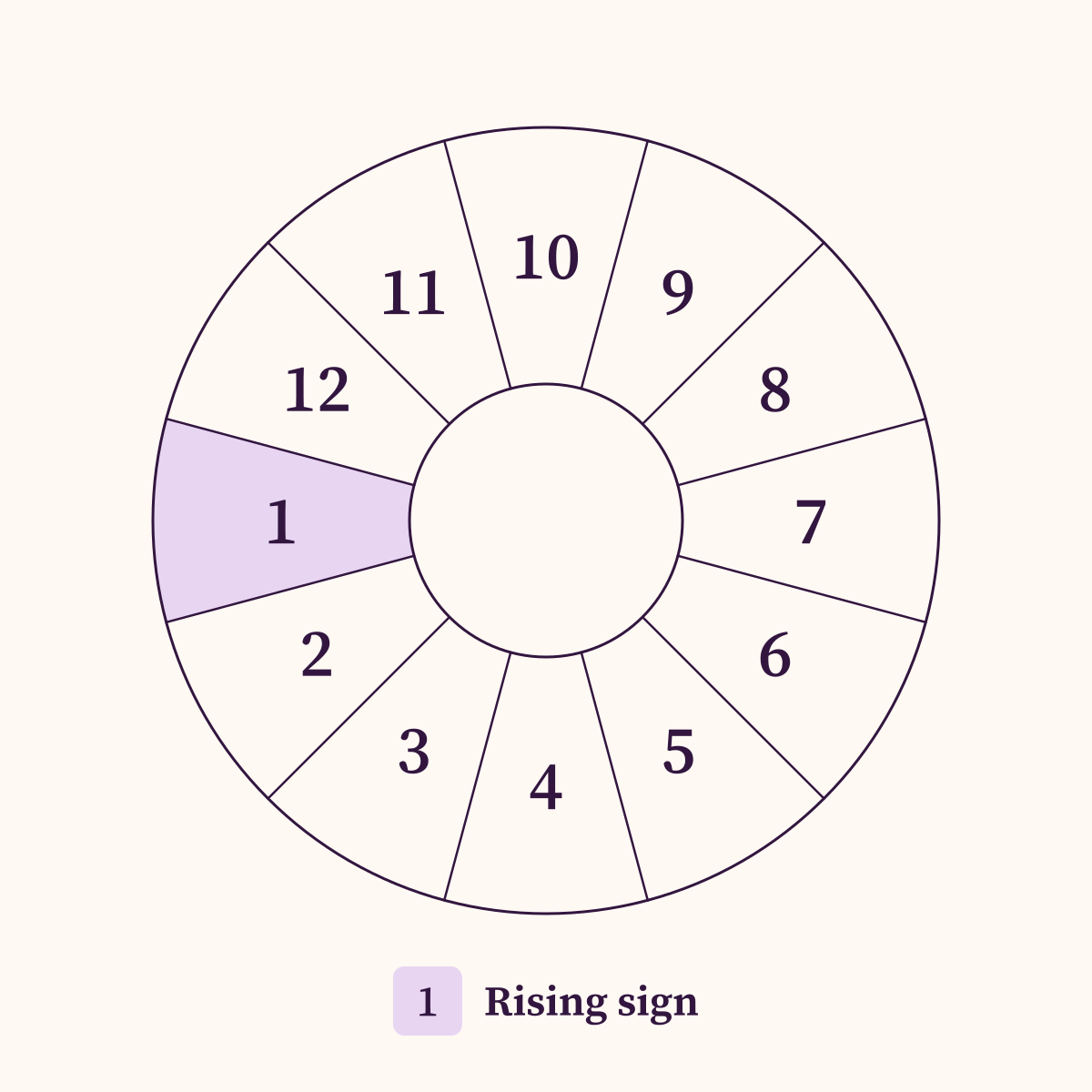
The oldest way to slice it is almost embarrassingly simple. Your rising sign, the sign sitting on the eastern horizon at your birth, is the entire 1st house. Not a slice of it. Not a portion. The whole sign. The next sign in zodiac order is the 2nd. The one after that, the 3rd. All the way around. Every house is exactly one full sign, and the 7th is always the sign sitting opposite your rising sign.
The Ascendant (the exact degree where the horizon crosses the ecliptic, the technical name for your rising) just lands somewhere inside that 1st house. It doesn't sit on a cusp or mark a boundary. It's in there, doing its thing.
To find any planet's house, you count from your rising sign to the planet's sign, counting the rising sign as one. Say you're a Virgo rising and your Venus is in Capricorn. You count: Virgo, Libra, Scorpio, Sagittarius, Capricorn. Five. Venus is in your 5th house. That's the whole method. Fingers and counting, if you want. No degree math required.
A whole sign chart looks like twelve perfectly even slices of pie, because every slice is one sign.
Placidus: houses measured in time
Placidus takes a completely different approach. Instead of cutting the zodiac into twelve equal chunks, it divides time. It takes the hours each degree of the zodiac spends traveling from the horizon up to the highest point of the sky (and coming back up from below), splits that time into thirds, and drops the house lines where the time breaks fall.[1]
Because some signs take longer to rise than others, and the exact timing depends on how far north or south you were born, the Placidus houses come out lopsided. One might squeeze into half a sign while its neighbor stretches across a full sign and a half. Your Ascendant degree marks the start of the 1st house, and the Midheaven (the point where the zodiac crosses the meridian above you, drawn at the top of the chart) marks the start of the 10th.
The farther you are from the equator, the more uneven the slices get. A friend born up in Finland might show you her chart and one house is a sliver while the next one is enormous. And past the polar circles, roughly 66 degrees north or south, some zodiac degrees never rise or set at all, so the method literally can't place every house.[1:1]
The system carries the name of Placidus de Titis (Placido Titi), a 17th-century Olivetan monk and professor of mathematics at the University of Pavia, who popularized it rather than inventing it.[2] Many chart apps default to Placidus because it's often described as the most commonly used house system in modern Western astrology.
Why your planet moved (and why plenty of others didn't)
So why does Venus land in the 1st in one system and the 12th in the other? In whole sign houses, the 1st house begins at the very start of your rising sign. In Placidus, it begins at your exact Ascendant degree, which can land late in that same sign. So if a planet sits in the first few degrees of your rising sign, before the Ascendant degree, whole sign calls it 1st (it's in the rising sign, full stop), but Placidus usually calls it 12th (it's already above the horizon, above the 1st-house starting line, so it falls back into the previous house).
That same principle ripples across the rest of the chart. Every other Placidus line also falls partway through a sign, and because the houses are uneven, some planets land one house earlier or later than they would under whole sign. Others land in the same house under both systems. You might check your Moon and find it's in the 4th either way. Only some planets drift, and which ones depends entirely on where the lines fall for your specific sky.
Why the house pages here use whole sign
Four reasons:
Each house is exactly one sign. The chart is easy to read, and a house's sign is never in doubt. No "is this cusp or is it not?" confusion.
Your rising sign is always your 1st house. A "your rising" reading and a "your 1st house" reading point at the same sign, every time. They never split into two different answers.
It works identically at every latitude. No squashed houses, no missing houses, no chart that only half-works because you were born in Reykjavik.
And it's thought to be the oldest system of house division: the main method in the Hellenistic tradition of astrology and still used in Indian astrology.[1:2]
Plenty of astrologers read Placidus charts fluently and find them rich. This is a choice with reasons, not a verdict on which system is "correct."
Your apps disagree. Now what?
Pick one system and read every planet in it. Here that means whole sign. If your app has a house-system setting, switching it to whole sign will match the house pages you're reading.
You can also check any app by hand. Find your rising sign, count from it to each planet's sign on your fingers, and compare the answer. It takes about ninety seconds the first time and about ten seconds after that.
The sign reading doesn't change at all. Venus in Libra reads as Venus in Libra whether the house lines call it 1st or 12th. The sign's flavor (air, cardinal, balance-seeking, relationship-oriented) stays exactly the same. What shifts is the area-of-life label, which is useful but not the whole story.
If you read the Placidus 12th-house description and it also resonates, you can notice that. That's fair. What doesn't help is picking, planet by planet, whichever house sounds more flattering and ignoring the other.
One thing both systems depend on: your birth time and place. An error in either moves the Placidus lines, and an error big enough to change your rising sign reshuffles every whole sign house at once. If your time is uncertain, getting it from your birth certificate or asking a parent to dig up the paperwork is the single most useful step.
Two quick asides before you move on: other house systems exist (Koch, Equal, and a few others), but you don't need to learn them tonight. And in whole sign houses, the Midheaven doesn't anchor the 10th house the way it does in Placidus; it can land in a neighboring house instead, which trips people up the first time they see it.
Back to your Venus
She didn't move. She's in Libra, in the same sign she was when you were born, in both apps. One set of fence posts puts her in the 1st, the "this is my face to the world" slice. Another set puts her in the 12th, the quiet, private, behind-the-scenes slice. Both are drawn by real rules. Neither is a glitch.
Now you know which rule your house pages follow, and you can stop refreshing the chart wondering which one is "real." Read the 1st house page for Venus. Feel how it lands. Maybe the 12th house description also hums, and that's part of the picture too. You know which fence each app drew now, and which house page is yours to read. The crisis dissolves into a simple, "Oh, that's where she is." And you can get back to actually reading about Venus in Libra, which is the fun part.
Wikipedia, House (astrology), sections 'Whole sign' and 'Placidus.' ↩︎ ↩︎ ↩︎
Wikipedia, Placidus de Titis, lead section. ↩︎