Moon Phases and Transits
Born on a New Moon: What It Means When Your Sun and Moon Start Together
Born on a new Moon, your Sun and Moon set out from the same spot in the sky, so what you're after and what you need arrive as one instinct.

In one week you gave notice, signed a lease across town, and told your best friend, in roughly that order. She put her coffee down and asked if you'd even thought it through. You had. You'd also felt it through, in the same breath, and the two never once argued. That's a new-Moon birth from the inside: your Sun and Moon set out from the same spot in the sky, so what you're after and what you need to feel okay arrive as a single instinct.
It makes you quick, wholehearted and very hard to talk out of things. It also means nobody inside you is arguing the other side, which is why the people around you matter more to this placement than you might expect.
The dark Moon you were born under
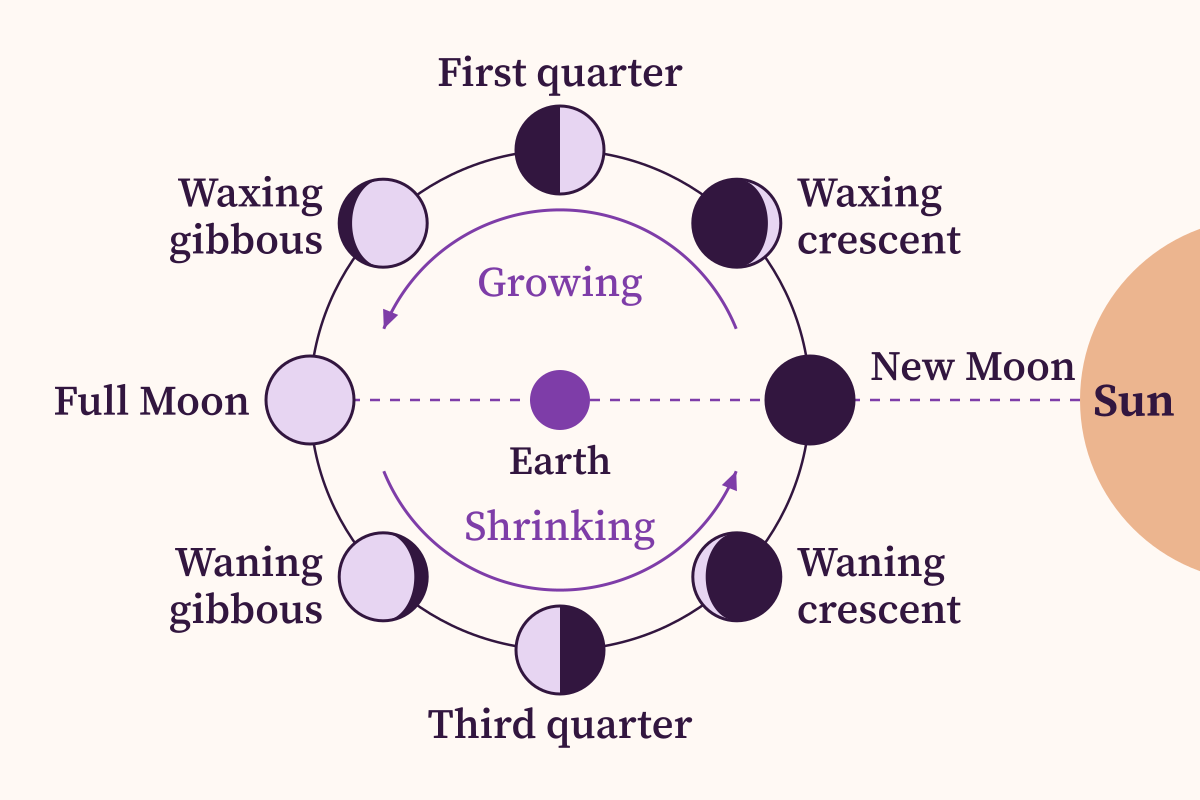
At a new Moon, the Moon's lit side faces the Sun and its night side faces Earth; it's in the same part of the sky as the Sun and up during the day, so it can't be seen.[1] Right around the exact new Moon, nobody looking up could have spotted it. Over the next two weeks the light grows back, and the whole cycle takes about 29.5 days: new Moon, waxing crescent, first quarter, waxing gibbous, full Moon, waning gibbous, third quarter, waning crescent.
Astrologers read the new Moon as the start of that cycle, the moment for beginnings. They read the phase you were born under as how your Sun and Moon work together, and it comes from the angle between the two at your birth. That angle is fixed for life. Tonight's Moon can be any shape it likes; yours stays new.
Same sign, or the one next door?
At the exact new Moon, the Moon is on the Sun's side of Earth, so it's in the same zodiac sign as the Sun. A phase lasts longer than that one moment, though. Divide the cycle into eight 45-degree phases centered on their exact moments, and the new-Moon phase takes in any Moon up to 22.5 degrees from the Sun. At the Moon's average gain of about 12 degrees a day on the Sun, that's a little under two days either side of the exact new Moon.
The Moon also moves far faster than the Sun. It runs through all twelve signs in about 27 days, while the Sun spends about a month in each one. Before the exact new Moon, the Moon is still behind the Sun, catching up. After it, the Moon has pulled ahead. Signs are equal 30-degree slices, so during the new-Moon phase your Moon can sit in your Sun's sign, the sign before it, or the sign after it.
That's how your chart can say Cancer Sun and Leo Moon while the calendar insists you're a new-Moon baby. A Cancer Sun born on a new Moon can have a Cancer Moon, a Gemini Moon (born in the day or so before the exact new Moon) or a Leo Moon (born just after).
If your signs match, your instinct speaks one sign's language twice, and the guide to matching Sun and Moon signs covers that in full. If your Moon landed next door, the timing is still unified while the styles differ. Neighboring signs share neither element nor modality: Gemini is mutable air, Cancer cardinal water, Leo fixed fire. Your wants take your Sun sign's style and your needs take your Moon sign's, and your Moon sign's own article describes those needs. Either way, you're a new-Moon birth.
How close counts
Born three or four days after the exact new Moon, you'd be a waxing crescent birth, pushing to build something new. Three or four days before, you'd be a waning crescent birth: reflective, finishing, needing quiet. The birth-phase guide walks through both.
Your birth date usually settles the phase. If the phase changed on your birthday, or the Moon changed signs that day (it does every two to two and a half days), your birth time decides. Phase timing and the Moon's sign come from chart software or a published lunar calendar, so check your chart with your birth time if you're close to a line.
One more thing you might spot. When your Sun and Moon are within several degrees of each other, your chart app may list "Sun conjunct Moon" in its aspect table. A conjunction is a 0-degree angle, shown with an orb of up to 8 degrees, so it's the same geometry as the tightest new-Moon births, filed under a different heading.
One instinct: when what you want and what you need agree
Your Sun is what you're going after: the self you're building and the purpose behind it. Your Moon is what you need: comfort, instinct, the reaction that shows up before the thought does. In plenty of charts those two have to negotiate. In yours they arrived together.
So what you want feels emotionally right, and what feels right turns into a plan almost before you've noticed it was a feeling. Friends call you certain. Wholehearted. All in. You rarely lie awake torn between head and heart, because they're usually saying the same sentence, and that makes you quick and honest about what you want. When you say yes, all of you says yes.
The phase itself says something simple: your Sun and Moon started out together. It doesn't make you naive, and it doesn't make you bad at finishing things.
It does make you built for beginnings. You're at your best on the first step: the first day, the pitch, the first conversation with someone new, the move to a city where you know exactly two people. The impulse arrives whole, and you frequently can't explain why until afterward.
The middle stretch asks more of you. Once the first rush settles, there's no second voice inside to argue for staying the course or changing it, so you do well with a reason that comes from outside: a deadline, a partner on the project, a friend who checks in on how it's going. You finish plenty of things. You just finish best with company.
The view you can't get from inside
One clear voice comes with a price, and the price is perspective. With your Sun and Moon in agreement, there's no internal debate to show you the other side. A strong mood can feel like a mission. A fresh plan can feel like the only plan there ever was.
That's why "you seemed so sure" can catch you off guard. You were sure. You just didn't know it showed that much, or that everyone else needed another month to catch up. Agreement doesn't come with a mirror. Other people do, which makes this one of the easiest growing edges to work with.
A full-Moon birth makes a useful comparison. It puts the two on opposite sides of the sky, a life of balancing two halves and spotting yourself in other people. You start from agreement instead. Both of you end up needing other people, for different reasons: the full-Moon person to hold the other half, you to see yourself from outside.
In love, with friends and family, and at work
In love
You know fast, and you fall with your whole self. So when your partner asks for a week to think about moving in together and you realize you've already decided where the couch goes, his pace can look like doubt. Most of the time he's just running on a slower clock.
What helps is a partner who reflects you back: someone who says what he sees, asks "are you sure?" kindly, and can argue the other side without it landing as a threat. You bring the energy and the certainty. The relationship gets better when you invite the second opinion instead of waiting for it to show up.
With friends and family
With friends, you're the one who says "let's go" and means it immediately. Your friends are your outside view, whether or not they signed up for the job. One of them remembers you said the exact same thing about your last job during its first two weeks. Another reads your big announcement before you post it, tells you how it sounds from out there, and it's the first time you've heard it that way.
Family tends to get the sudden version. You announce the move at your parents' dinner table, your dad asks when you decided, and the honest answer is "just now, and also for months." The deciding happened inside, all at once, with no back-and-forth anyone could watch.
At work
Launches, pitches, first drafts, new clients: you shine when something is starting. You pitch an idea with total conviction, a coworker asks the one awkward question in the meeting, and that question ends up saving the project. Keep that coworker close. The habit that makes you better at work is asking for feedback before you commit, while changing course is still cheap, instead of after.
Before the next thing you start
Pick your outside eyes on purpose. Choose one person whose read you trust, maybe the oldest friend, the coworker with the awkward questions, or the partner who's allowed to say "are you sure?" Then choose one question to ask them first: "What am I not seeing?"
You'll still leap. That's the best part of being born under a dark Moon, and nobody needs you to stop. This time the second opinion arrives before the leap instead of after it, while it can still change where you land.
NASA Science, Moon Phases, All Moon Phases. ↩︎