Moon Phases and Transits
Moon Phases and Their Meanings
The Moon moves through eight phases each month, from new to full and back again, and this guide gives a small, concrete thing to try at each one.
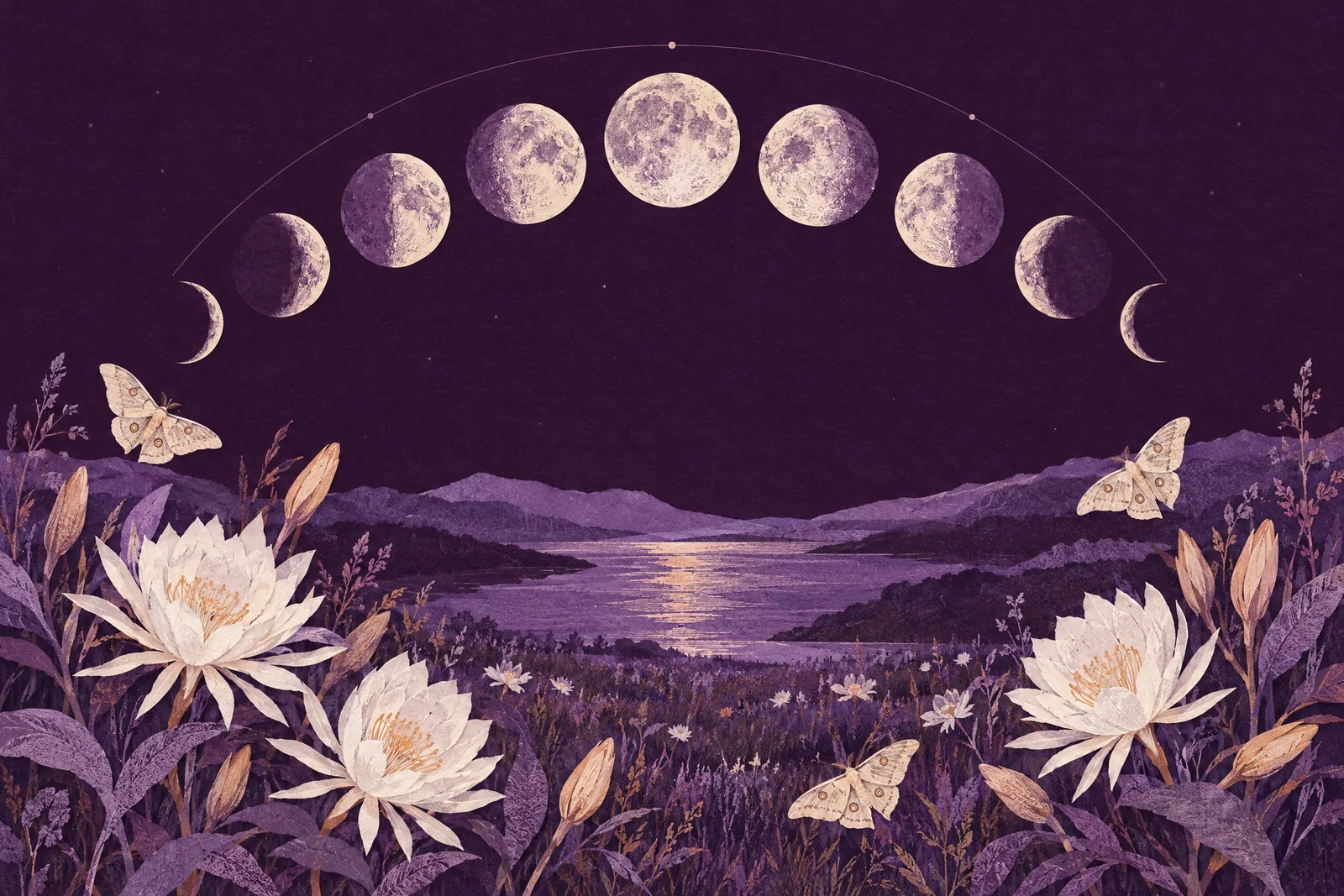
You know that moment when the full Moon is so huge and orange over the highway that you actually pull over, kill the engine, and just look at it? The Moon was full that night, and a full Moon rising low over the highway is one of the best free shows in the sky.
But here's what most moon phase charts miss: the full Moon is only one night out of about 29.5. The rest of the cycle is quieter, slower, and honestly more useful to pay attention to than any single night. The Moon moves through a rhythm every month. You begin, build, adjust, hit a peak, share what you learned, clear it out, and rest before the whole thing starts again. Eight phases, and you can feel the shape of the cycle even if you never check an app.
What's happening in the sky
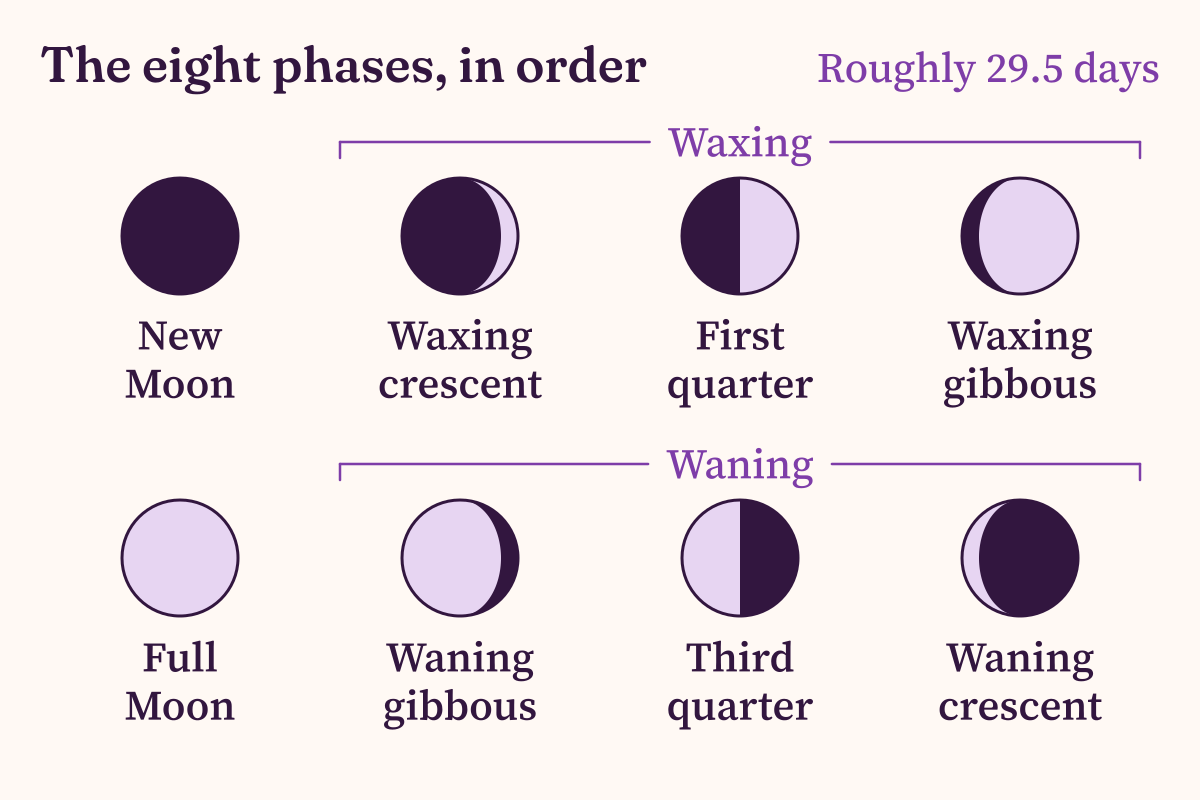
The Moon doesn't make its own light. It bounces sunlight back at us, and as it orbits Earth over roughly 29.5 days, the angle between the Moon, Earth, and Sun keeps shifting. That changing angle is what creates the phases.[1]
At the new Moon, the Moon sits between the Sun and Earth. Its lit side faces the Sun, and the dark side faces us, so the Moon is basically invisible in the night sky. Two weeks later, at the full Moon, the Moon is on the opposite side of Earth from the Sun. Its whole face catches the light, and you get that round, bright disc you can read a book by.
In between those two extremes sit six more phases, and together they make up the full cycle. The eight, in order, are: new Moon, waxing crescent, first quarter, waxing gibbous, full Moon, waning gibbous, third quarter, and waning crescent.
What waxing and waning actually mean
"Waxing" means the lit portion is growing. You're watching the Moon fill up, from a thin sliver after the new Moon to the full disc. "Waning" means the lit portion is shrinking, from full back down to the last sliver before darkness.
That split matters in how people use the cycle. The waxing half, the build-up from new to full, is associated with growth, momentum, and pushing forward. The waning half, the slide from full back toward new, is associated with sharing, letting go, and winding down. You're either filling or emptying. Both halves are useful; you just use them for different things.
New Moon, waxing crescent, and first quarter
The new Moon is dark, quiet, and invisible. Astrologers treat it as the reset button of the month: a clean slate, a chance to plant a seed before there's any structure yet. You don't have to see the Moon to know it's there, and you don't have to have a grand life plan to start. The simple move: sit down and write one intention for the next cycle. One sentence is enough. "I want to feel more settled in my apartment." "I want to stop saying yes to things I don't want to do." Write it, date it, close the notebook.
The waxing crescent is that first thin curve of light, maybe a day or two after the new Moon. The dark Moon is still mostly there, but now you can see the edge catching fire. Astrologers read this as the first small steps after a decision. The thing is no longer just a thought; it's getting a shape. Do one small action toward whatever you wrote down. Send the email. Put the shoes by the door. Buy the fabric. Something tiny that says you meant it.
The first quarter is half lit. The Moon looks like a D or a C depending on where you are, and half of it catches the light. Astrologers mark this as the first real obstacle or decision point. You started something, and now the newness has worn off. The plan hit a snag, or you realize the plan was a little too neat. This is where you adjust. Not quit. Not pretend everything's fine. Look at what isn't working, change one thing, and keep going.
Waxing gibbous and full Moon
The waxing gibbous is the lumpy, almost-full Moon. More than half lit but not quite there yet, the lit side swelling toward full. Astrologers associate this phase with refining and patience. You're close but not done, and the temptation is to rush the finish line. Instead, you edit. You practice. You run through the presentation one more time, rework the second verse of the song, proofread the application you've been sitting on. The work isn't starting anymore; it's getting sharper.
The full Moon. Fully lit, fully round, the brightest thing in the night sky. Astrologers read this as culmination and visibility. What you started at the new Moon is now out in the open, done or undeniably visible. Things come to light that were hiding: a project lands, a friendship shifts, you can't un-know what you know. Two things to do. First, celebrate what actually worked, even if it's small. Second, name what's too much. The full Moon shows you the whole picture, and sometimes part of that picture is "I took on a third client and I'm already stretched."
Waning gibbous, third quarter, and waning crescent
The waning gibbous is still big but shrinking, the first bite taken out of the full disc. Astrologers link it to sharing and gratitude. You had something happen, you learned something, and now the energy turns outward. You're past the peak and into giving back. Do one generous, low-effort thing. Text the friend who talked you through that hard week. Teach your coworker the shortcut you figured out. Pass on the book that changed how you think about something. You don't owe anyone a grand gesture. Gratitude is just saying "that meant something" out loud.
The third quarter is half lit again, but now it's the other half. The light is shrinking instead of growing. Astrologers read this as the clearing phase. Whatever ran its course by now, let it go. You don't need a ceremony. Do the thing you've been avoiding: unsubscribing from the newsletter, admitting the side project isn't working, cleaning out the folder you've been meaning to delete. Drop one thing that isn't working anymore.
The waning crescent is the last sliver, a thin curve of light just before total darkness. The Moon is barely there, and the whole cycle is about to reset. Astrologers treat this as rest, reflection, and quiet. Everything that was building has peaked and been shared; the sky is asking you to slow down before the next round. Do less. Sleep in if you can. Journal if that's your thing, but honestly, lying on the couch doing nothing is also valid. You just cleared out a bunch of stuff, and the next new Moon will come whether you're ready or not. Save the energy.
Moon phase vs. Moon sign
These two things get mixed up constantly, and they're really not the same.
The Moon's phase is the shape of its light, determined by its angle to the Sun and Earth. That's the astronomy. New, waxing crescent, first quarter, and so on, cycling through in about a month.
The Moon's sign is where the Moon sits in the zodiac, passing through Aries, Taurus, Gemini, and the rest. It moves through a sign roughly every two to two and a half days, so it completes all twelve signs in about a month. Your natal Moon sign is fixed from the moment you're born and describes your emotional instincts. The current Moon sign shifts every couple of days and colors the general vibe of the day.
You can be a Scorpio Moon living through a Taurus season, or catch the Moon transiting Leo while the phase says first quarter. Phase and sign are independent clocks running on the same body. If someone tells you "the Moon is in Sagittarius, waning gibbous," that's two separate pieces of information, not a contradiction.
Try tonight
You don't need an app subscription, a special chart, or a moon phase tracker on your home screen. Look up. If you see the Moon, note its shape. Then pull up any lunar calendar or weather app, type in your location, and check the phase for tonight. It's free and takes about eight seconds.
Once you've got the phase, pick the one small move that goes with it. Write a sentence. Send a text. Drop one thing. Sleep in. None of it promises a result. You're just giving the next few days a slightly different shape than they'd have without the nudge, and that's honestly the whole point of paying attention.
NASA Science, "Moon Phases," https://science.nasa.gov/moon/moon-phases/, accessed September 25, 2026. ↩︎