Moon Phases and Transits
Should You Read Your Horoscope for Your Rising Sign or Your Sun Sign?
Every sign horoscope is a house reading with the counting done for you. Your chart's houses start at your rising sign, so read the rising column first.

Read the horoscope for your rising sign first. The Sun-sign one stays useful, but if you know your rising sign from a reliable birth time, the rising column is the one whose houses match your chart.
You've probably met the reason already. Your Sun-sign horoscope promises a big week for partnerships, and you're single, at home, alphabetizing your bookshelves. The sky in that horoscope was fine. The part of life it sent the sky to came from a count that doesn't start where your chart starts. Every sign horoscope is a house reading with the counting done for you, and the houses in your chart begin at your rising sign.
What a sign horoscope is actually doing
Every sign horoscope does two jobs. First it describes the sky: a new Moon in Scorpio, Mercury changing signs, whatever season the Sun is in. That layer is the same for everyone, because a sign season or a planet in a new sign is a shared emphasis on that sign's themes. It's the weather report at the top.
Then it gets personal. It tells each sign which house the sky lands in, counted from that sign: "the new Moon falls in your 7th house of partnership." A house is a part of life (relationships, home, work, friends), and it's where the theme shows up for you. Your birth chart stays exactly where it was the day you were born. The horoscope tracks the moving sky as it passes through your houses.
So "which horoscope should I read?" comes down to a single question: which sign should the count start from?
Why your rising sign holds the key
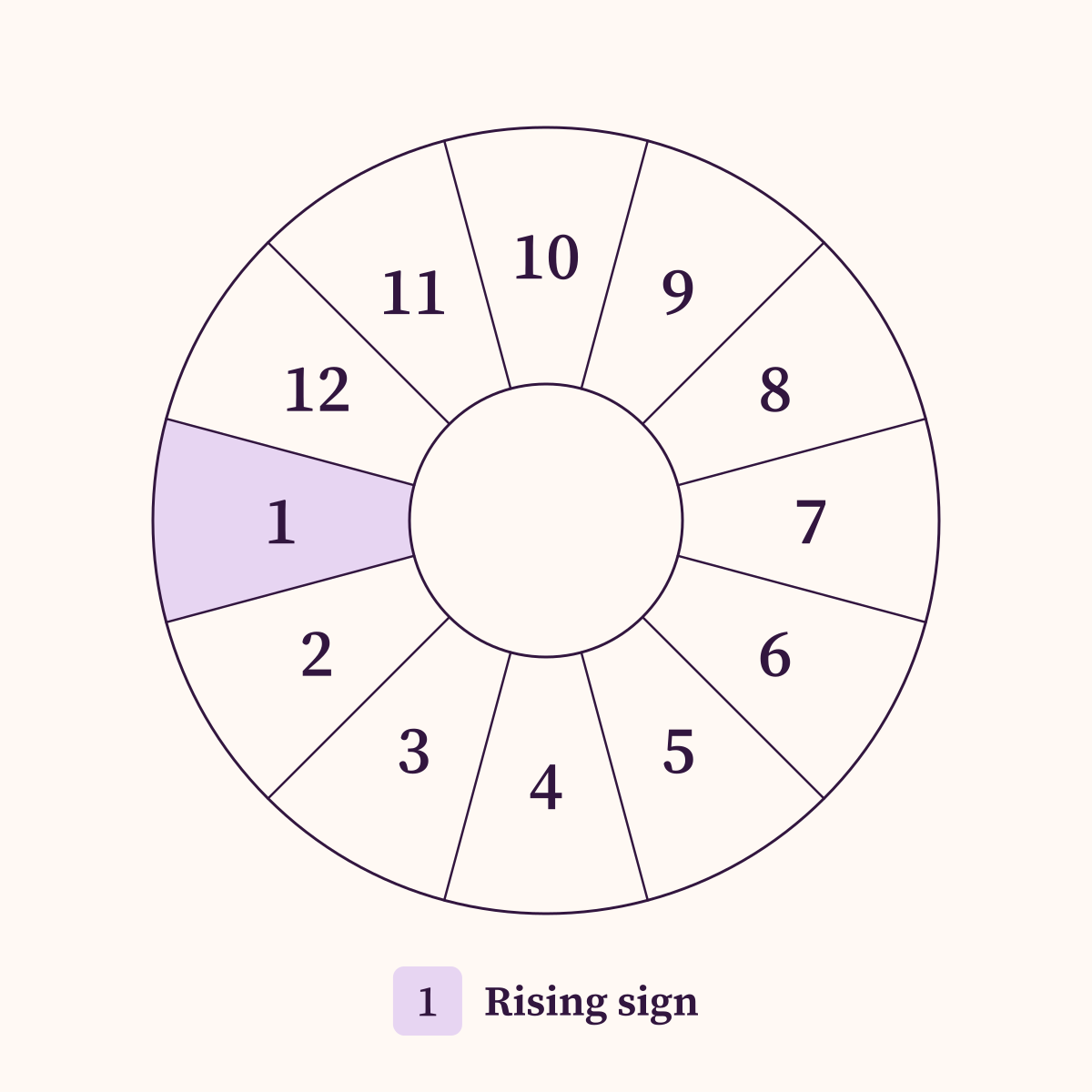
The houses in your birth chart start from your rising sign. Count whole sign houses from your rising sign and it fills the 1st house, with each following sign taking the next. A horoscope written for your rising sign counts from the same starting point, so its 3rd house is your chart's 3rd house and its 10th is your chart's 10th. That's the whole case for reading it: it lands the week in the part of life your own chart says it lands in.
It also explains a familiar breakfast scene: your sister, who shares your Sun sign, reads her horoscope out loud, and it only fits one of you. Her Sun column is word for word yours. If her rising sign differs from yours, the rooms in her chart are numbered from a different door.
Fit isn't the test, though. The rising column earns first place because of where its count begins, and that holds on the weeks it sounds a little off, too.
The word itself points the same way. Horoscope comes, through Latin, from the Greek hōroskopos, built from hōra ("time, hour") and skopos ("observer, watcher"), and in Greek the word was also used for the ascendant.[1] The ascendant is the rising point, and your rising sign is the sign it sits in. So the hour watcher that gave the whole practice its name was the rising point all along.
One week, read twice
Say you're a Taurus Sun with Virgo rising, and the week brings a new Moon in Scorpio and Mercury moving into Sagittarius.
The weather is the same in both columns. A new Moon is read as a beginning and a time for intentions, and in Scorpio (fixed water: intensity, privacy, depth) it's a quiet, private fresh start, the kind of intention you keep to yourself until it's real. Mercury is thinking, talking and learning, and in Sagittarius (mutable fire: exploration, conviction, the wider view) it turns conversations toward big questions and blunt honesty.
Then the counts split.
| The sky | Sun column, counted from Taurus | Rising column, counted from Virgo |
|---|---|---|
| New Moon in Scorpio | 7th house: a fresh start in a partnership or a one-to-one relationship | 3rd house: a fresh start in how you talk, write, learn and get around your neighborhood |
| Mercury into Sagittarius | 8th house: deeper conversations about what you share with someone, and how open you let yourself be | 4th house: conversations that turn toward home, roots and your private life |
Read the Sun column and the week is about another person. Read the rising column and it's about a class you've been circling, a writing habit, a new route through your neighborhood, and then talks that drift toward home. Same sky, different rooms. Both columns describe themes, never events: a house names the part of life a theme visits, and what you do with it is up to you.
The gap is pure arithmetic. Virgo sits four signs after Taurus, so every house in your Sun column is four houses off from your chart's house for the same sign: solar 7th and chart 3rd for Scorpio, solar 8th and chart 4th for Sagittarius.
What your Sun-sign horoscope is good for
A Sun-sign horoscope treats your Sun sign as the 1st house and counts from there. Astrologers call this solar houses, and it's the long-standing horoscope convention because a birthday is all anyone needs to know a Sun sign, so one column can serve every reader. It's a real technique with a clear job.
Its limit is the shift. Unless your Sun and rising are the same sign, its houses sit over from your chart's houses by the distance between the two signs. The sky it describes is right; the room comes from a count that starts at your Sun instead of your chart's 1st house.
That still leaves it plenty to do. The weather layer at the top of any horoscope applies to everyone, so the Sun column's take on a Scorpio new Moon is worth your time no matter what's rising. And if your Sun and rising match, say Capricorn and Capricorn, solar houses and your chart's houses are identical. You were reading the right column all along and get to skip this entire argument.
If your birth time is missing or shaky
A rising sign depends on an accurate birth time and place, and it changes roughly every two hours, so without a reliable time there's no definite rising sign, and the Sun column is the honest default. That's exactly the situation the convention exists for.
A shaky time is its own case. If your recorded time sits close to a rising-sign change, your rising could be either of two signs. Until the time is settled, stick with the Sun column. Picking whichever rising horoscope sounds more like your week feels clever, but it means your mood chose your rising sign.
Then there's the app that shows a rising sign even though you never entered a birth time. You have no idea where it came from because it came from nowhere solid: a rising sign from a chart made without a time is a guess, however confident the screen looks.
One last source of mix-ups: many chart apps default to other house systems, such as Placidus, which divide the chart differently, so your app can show a planet one house over from where a horoscope puts it.
Your new reading order
If you haven't tracked down your recorded birth time yet, do that first: the birth certificate, the hospital record, whatever your family kept. Once you have a time you trust and the rising sign that comes with it, make that column the first thing you open each week.
Keep the Sun column, too. Read its top paragraph for the weather, then go to your rising column to find out which room in your life the weather is walking into.