Zodiac Guides
Zodiac Stones vs. Birthstones: Why Your Birthstone Isn't Your Sign's Stone
Your birthstone follows your birth month and your sign stone follows the Sun, so both are yours. Here's why the two lists differ and get mixed up.
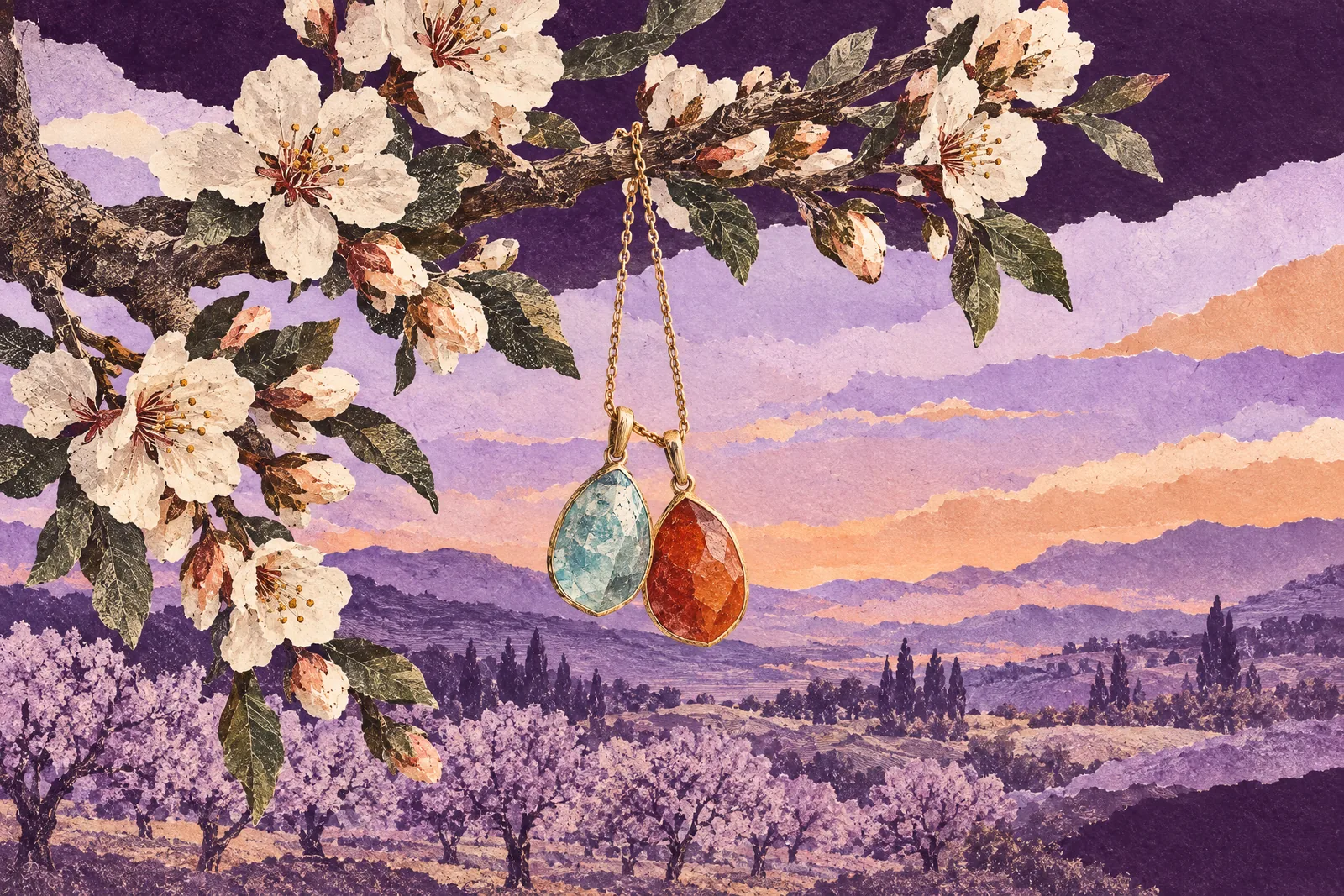
Say you've worn aquamarine for years because it's your birthstone, and some chart you found online just told you the Aries stone is carnelian. So which one is yours? Both of them. You're standing at the overlap of two calendars that count your birthday differently, and once you see how they each work, the whole thing clicks into place. Your birthstone answers "what month were you born in?" Your sign stone answers "where was the Sun?" A late-March birthday means your calendar month says March and your Sun is already in Aries, which is why you've been wearing aquamarine while the astrology world keeps saying carnelian. Neither one is wrong. You just get to claim both.
Your birth month and your sign are two different calendars
A birthstone follows the twelve calendar months. January, February, March, and so on, all starting on the 1st and ending on the 31st or 30th. A zodiac sign follows the Sun's actual journey through the sky, and the Sun doesn't clock into a new sign on the 1st of anything. It crosses over on a day somewhere between the 19th and the 23rd, which means every sign holds the tail end of one month and most of the next. Aries runs from late March to late April. That's two calendar months for one sign. And every calendar month gets shared by two signs, because one sign is finishing up while the next one starts.
Put it in your birthday terms. A late-March Aries and an early-March Pisces both share March's birthstone, aquamarine. But the Aries gets carnelian as their sign stone and the Pisces gets aquamarine, because their Suns were in different signs even though their birthdays landed in the same month. A late-March Aries and a mid-April Aries share carnelian as their sign stone even though they have different birthstones. Two calendars, one birthday, and both stones are legitimately yours.
If you were born between the 19th and the 23rd of any month, your Sun sign can depend on your exact birth time, which means your sign stone can too. A fixed date table can't settle that. You'd need to calculate the chart.
Birthstones: a jewelers' list from 1912 (with a much older ancestor)
The monthly birthstone list almost everyone in the US knows today isn't handed down from antiquity. In August 1912, the American National Association of Jewelers, now called Jewelers of America, got together in Kansas City and agreed on a standard list so that every jeweler in the country would stock the same stones for each month.[1] Before that, different regions and different jewelers used different stones for the same month. The 1912 meeting is what gave you "buy the garnet for January, the sapphire for September" as a shared gift-giving script.
That list has been edited several times since. The 1952 revision added alexandrite, citrine, and pink tourmaline, and swapped zircon in for lapis lazuli. Tanzanite joined December in 2002, and spinel joined August in 2016.[2] Britain's goldsmiths published their own list in 1937, so if you've ever been confused about whether your November birthday means topaz or citrine or both, you're not imagining it. The list has moved around, and it moves differently in different countries.
All of that is a perfectly nice thing to love. The tradition is a trade standard that turned birth-month gift-giving into something every aunt and coworker could get right without needing an astrology degree. Your aquamarine is yours because you were born in March, and that's a whole tradition by itself.
But the idea that twelve stones map to twelve units of time goes back further than a Kansas City hotel ballroom. The first-century historian Josephus wrote that the twelve stones on the high priest's breastplate could be understood as the twelve months or as the twelve signs of the zodiac.[3] Later writers ran with both readings, and the two lists drifted apart over centuries. The breastplate gave the custom its shape, but the specific stone-by-month assignment most people recite is a twentieth-century retail invention, and there's no shame in that.
Zodiac stones: no single list, and that's why charts disagree
Sign stones never got their Kansas City moment. There was no meeting, no industry standard, no one body that said "carnelian for Aries, period, from now on." Different books, different crystal guides, and different online charts have assigned different stones to different signs for generations, and they still do.
George Frederick Kunz's 1913 book listed bloodstone for Aries, sapphire for Taurus, agate for Gemini, emerald for Cancer, onyx for Leo, carnelian for Virgo, chrysolite for Libra, beryl for Scorpio, topaz for Sagittarius, ruby for Capricorn, garnet for Aquarius, and amethyst for Pisces. Notice that Kunz gave Virgo carnelian and Aries bloodstone, which is almost the opposite of what most modern crystal charts say. His list was one author's reading of one tradition, not a consensus.
Today's crystal guides tend to choose sign stones by color and character. Carnelian's ember red matches Aries, a cardinal fire sign built on initiative and urgency. Moss agate, with its tiny green garden patterns, fits Virgo's earthy love of refinement and practical detail. Moonstone for Cancer makes sense because its milky silver glow suits the water sign's protective, memory-keeping character. It's a correspondence chosen because the stone's look and feel echo what the sign is about.
The sign stones in the table below come from that color-and-character matching. They're the ones a given crystal guide assigns. Another guide might say something different, and that's the nature of a list with no governing body.
Your birthstones and your sign stone, side by side
| Sign | Months it spans | Birthstones for those months | Sign stone |
|---|---|---|---|
| Aries | Late March to late April | Aquamarine (March), diamond (April) | Carnelian |
| Taurus | Late April to late May | Diamond (April), emerald (May) | Rose quartz |
| Gemini | Late May to late June | Emerald (May), pearl/moonstone/alexandrite (June) | Citrine |
| Cancer | Late June to late July | Pearl/moonstone/alexandrite (June), ruby (July) | Moonstone |
| Leo | Late July to late August | Ruby (July), peridot/spinel (August) | Sunstone |
| Virgo | Late August to late September | Peridot/spinel (August), sapphire (September) | Moss agate |
| Libra | Late September to late October | Sapphire (September), opal/tourmaline (October) | Opal |
| Scorpio | Late October to late November | Opal/tourmaline (October), citrine/topaz (November) | Obsidian |
| Sagittarius | Late November to late December | Citrine/topaz (November), turquoise/tanzanite/blue zircon (December) | Turquoise |
| Capricorn | Late December to late January | Turquoise/tanzanite/blue zircon (December), garnet (January) | Garnet |
| Aquarius | Late January to late February | Garnet (January), amethyst (February) | Amethyst |
| Pisces | Late February to late March | Amethyst (February), aquamarine (March) | Aquamarine |
Why the two get mixed up
Six sign stones happen to double as a birthstone for one of that sign's months: Cancer's moonstone is also June's stone, Libra's opal matches October, Sagittarius's turquoise shows up in December, Capricorn's garnet is January's, Aquarius's amethyst is February's, and Pisces's aquamarine is March's. So a January Capricorn wears one garnet and gets a birthstone and a sign stone in the same ring. A Capricorn born the week after Christmas, though, has turquoise, tanzanite, or blue zircon as their birthstone, because they were born in December. Same sign, same stone for the sign, different stone for the month.
That overlap is useful for gift-givers and confusing for everyone else. Add in the charts titled "zodiac birthstones" that just splice the month list and the sign list together under your sign's name, and suddenly you're staring at a pin with six stones and no idea which half is the calendar and which is the chart. And older zodiac-stone lists add another layer, because a 1913 book might say Aries gets bloodstone while your current crystal app says carnelian. Three sources, three answers, one Aries.
The blur isn't a mystery. It's two lists sharing a root, drifting apart for centuries, and then the internet putting them on the same graphic without labeling which line belongs to which system.
Birth flowers work the same way
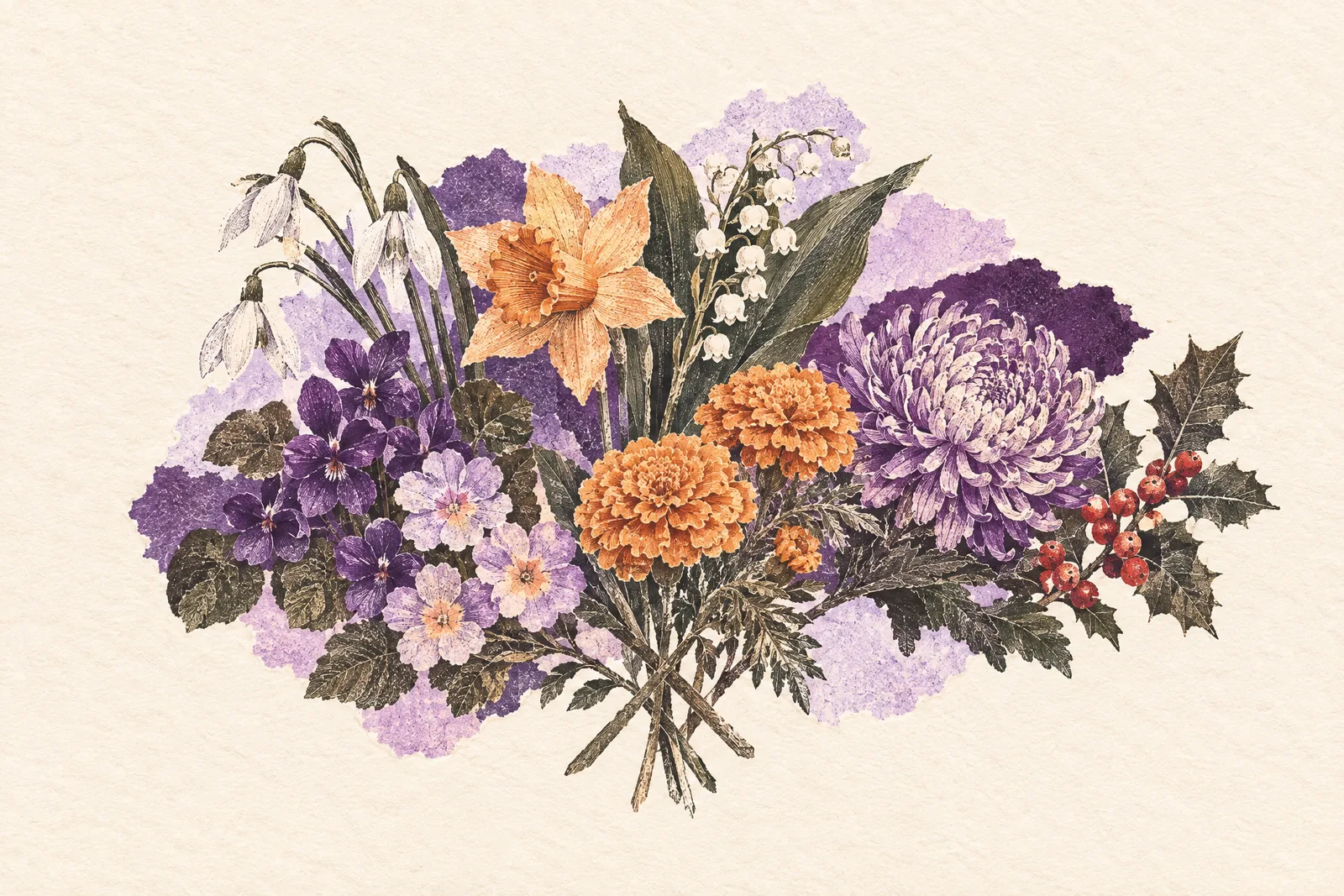
The exact same split shows up with flowers, and it trips people up in the identical way. The Old Farmer's Almanac assigns flowers to calendar months: carnation and snowdrop for January, violet and primrose for February, daffodil for March, daisy and sweet pea for April, lily of the valley and hawthorn for May, rose and honeysuckle for June, larkspur and water lily for July, gladiolus and poppy for August, aster and morning glory for September, marigold and cosmos for October, chrysanthemum for November, and narcissus and holly for December.[4] That list tracks the month, just like birthstones do. The Almanac also notes that not every culture agrees on which flowers belong to which months.
Sign flowers follow the sign instead, the same way sign stones follow the Sun. So if you're a late-March birthday looking for your flower, the month says daffodil and the sign says something else, and you get the same "which one is right?" loop you got with the stones.
Wear both, and say which is which
Both your stones are yours; they're just answering different questions. The birthstone is the birthday tradition. It's what the jeweler stocks by month, what your coworker can grab at the mall knowing only your birthday, and what's been a fun shared ritual since a group of American jewelers sat down in 1912 and made it official. Your sign stone is the astrology one. It needs your Sun sign, and it ties the stone to the sign's element and character rather than to a calendar page.
There's no rule that says pick one. An aquamarine on a chain and a carnelian on the same chain say "I was born in March and I'm an Aries" to anyone who knows the code. A January Capricorn stacking garnet twice is both correct and slightly smug, which feels right. For a mid-November Scorpio, a friend can give topaz for the month and obsidian for the Sun, and now there's a whole matching set instead of one sad pendant and a shrug.
So name your pair out loud. "My birthstone is aquamarine, my sign stone is carnelian, and yes, both of them are mine." The next time someone sends you a "zodiac birthstone" chart and asks why your stone doesn't match, you've got the whole answer in two sentences.
Jewelers of America, Birthstones, introduction and monthly list. ↩︎
Wikipedia, Birthstone, section 'Modern birthstones.' ↩︎
Project Gutenberg, The Curious Lore of Precious Stones, by George Frederick Kunz (1913), chapter on birthstones, original pages 309 to 320. ↩︎
The Old Farmer's Almanac, What Is My Birth Flower? Birth Month Flowers, birth month flower list. ↩︎