Zodiac Guides
Crystals for Each Zodiac Sign (and Why Each One Fits)
A sign's stone should look like the sign: ember reds for fire, greens and pinks for earth, bright stones for air, sea tones for water, plus an alternate.
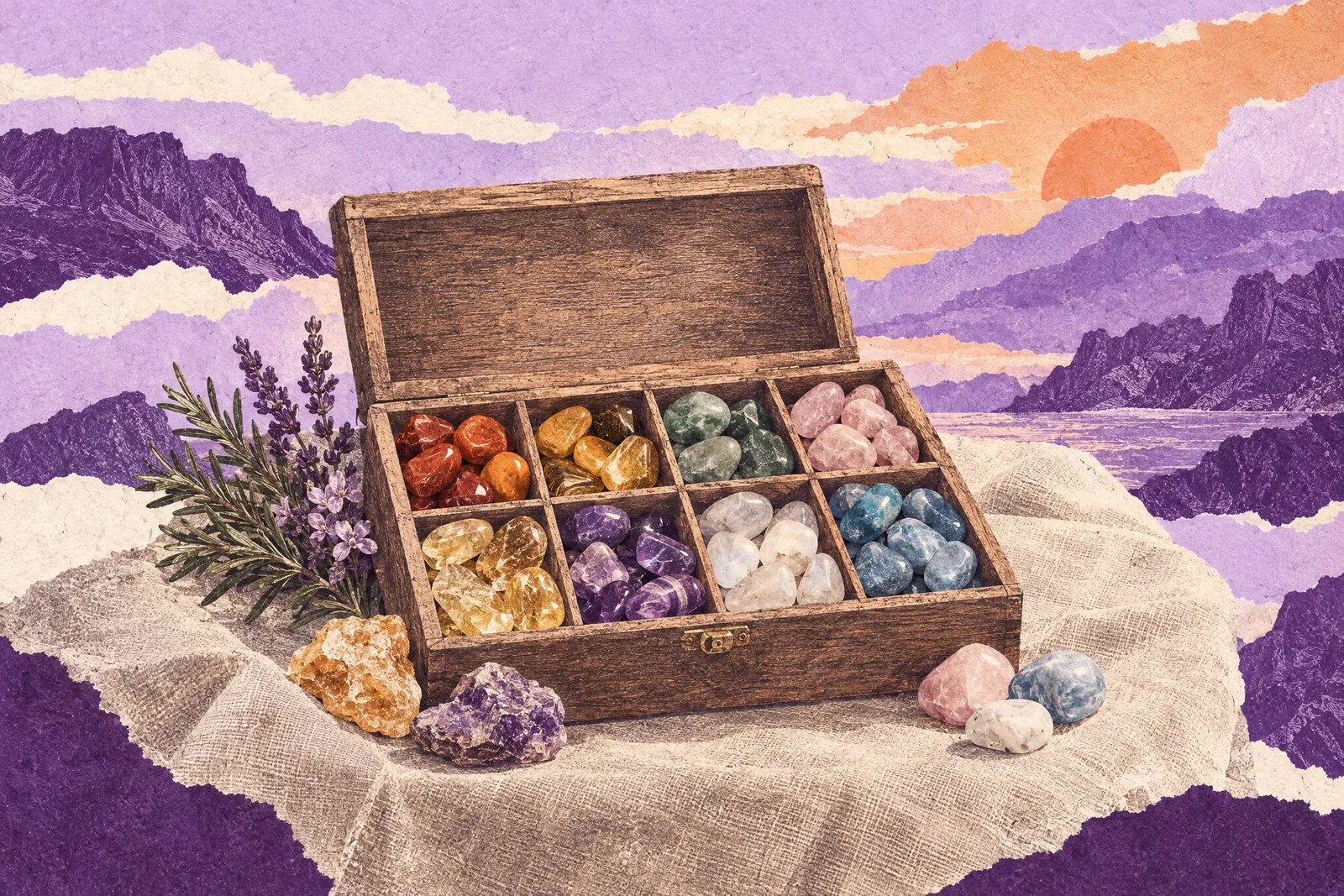
You've got three crystal-by-sign charts saved in your phone, and your sign gets a different stone on every single one. One says emerald, another says jasper, the third swears your answer is a smoky quartz you've never even seen in a shop. The confusion is understandable: these lists were built on different logics over different centuries, and nobody has ever agreed on a tidy set.
But there's a simple way to pick that stops the spinning. A sign's stone should look like the sign. Color carries the element. Ember reds and golds for fire, garden greens and soft pinks and wine reds for earth, bright or light-shifting stones for air, milky and glassy and sea-toned stones for water. Then the stone's character does the rest. Moss agate keeps a tiny garden inside that you only notice up close. That's Virgo in a sentence.
Pick the stone you can hold, wear, or set on your desk. One main match per sign, one alternate, and a reason you could explain to a friend over coffee.
How these stones were chosen (and why older lists disagree)
Sign-and-stone pairings are symbolic correspondences, and sources disagree about many of them. George Frederick Kunz's 1913 book The Curious Lore of Precious Stones gave the zodiacal gems as bloodstone for Aries, sapphire for Taurus, agate for Gemini, emerald for Cancer, onyx for Leo, carnelian for Virgo, and so on, reading like a jeweler's case rather than a mood board. An older Spanish list Kunz noted differs again. [1] Today's crystal charts lean on color and feel, which is closer to how you'd actually pick something off a shelf.
This list commits to one reason per stone: color for the element, character for the sign's modality and themes. Put simply: carnelian is the Aries stone. Here's why.
Fire signs: stones that look lit
Aries: carnelian. Translucent red-orange, the color of a coal right before it flares. Cardinal fire starts things now, and carnelian looks lit from the inside. You dig for your keys and find the carnelian you dropped in that jacket pocket last month, still warm from being carried. Alternate: red jasper, opaque brick red, for the Aries who wants the same heat in a steadier, earthier form. Where it lives: the key ring or the jacket pocket you grab on the way out, because you're usually halfway out the door already.
Leo: sunstone. Warm orange-gold with glittery flashes when it moves. Fixed fire keeps its warmth going, and sunstone looks like late-afternoon light caught and kept. This is the stone to wear where people will see it: a ring, a statement pendant, earrings that catch the light across a dinner table. Alternate: tiger's eye, golden-brown bands that shimmer like a cat's eye as it turns, a nod to the lion that stays subtle.
Sagittarius: turquoise. Opaque sky blue shading toward green, the color of distance. Sagittarius breaks the fire pattern on purpose, and that's what makes it easy to remember: it's fire aimed at the horizon, so its stone looks like the place it's headed. Turquoise is porous and fussy, though. Heat, chemicals, cosmetics, and even skin oils can discolor it, so it comes off before sunscreen and lotion. Alternate: golden topaz, a clear warm gold, for the Sagittarius who wants the fire back. Where it lives: the travel bag, always.
Earth signs: stones you want to hold
Taurus: rose quartz. Soft, milky pink, smooth, with a pleasant weight in the palm. Fixed earth wants comfort it can touch and keep, and rose quartz is the stone people end up turning over without noticing. It's one of the easy ones to live with, too. Rose quartz is generally stable when exposed to light and heat, so a nightstand or a bright shelf works. Your rose quartz has sat on the nightstand so long you only notice it when you pick it up to dust. Alternate: green aventurine, a garden green with a faint shimmer, for the Taurus who'd take the backyard over the bouquet.
Virgo: moss agate. Translucent, with fine green threads inside that look like a forest floor under glass. Mutable earth notices small things and makes them better, and moss agate is a stone that rewards a close look. Put it next to the planner and the good pens on your desk. Alternate: amazonite, a soft opaque blue-green, calm and uncluttered.
Capricorn: garnet. Deep wine red, dense, with an heirloom look. Cardinal earth builds things meant to last, and garnet is the stone that looks like it's already been handed down once. An everyday ring is where it belongs, the kind you stop noticing because it's always on. Alternate: smoky quartz, translucent gray-brown like woodsmoke, understated and serious.
Air signs: bright, clear, and light-shifting
Gemini: citrine. Clear, sunny yellow, the brightest stone on this list. Mutable air moves toward whatever's interesting, and citrine has that quick, lit-up look. Keep it beside the laptop or the notebook you write in, but not on a sunny windowsill. Some citrine can fade with prolonged exposure to intense light, and abrupt temperature changes can cause citrine to fracture. Alternate: fluorite, often striped purple, green, and clear in a single stone, a good match for a sign that holds several moods at once.
Libra: opal. Opal shows several colors at once without letting one take over, which is Libra's talent: cardinal air opening a conversation and keeping every voice in it. It's also delicate. Opal contains up to 20 percent water in its structure, and heat from intense light can cause fine cracks called crazing, and high heat or sudden temperature changes can fracture it. [2] So it's a jewelry stone, worn out for the evening, stored in a soft pouch, never parked on a sunny sill. Alternate: lapis lazuli, deep blue flecked with gold, for the Libra whose idea of beauty is classic and composed.
Aquarius: amethyst. Violet quartz, cool-toned and a little unexpected. Fixed air holds on to its own ideas, and amethyst is the stone that insists on purple. Keep it out of direct sun. Some amethyst can fade with prolonged exposure to intense light, and abrupt temperature changes can cause amethyst to fracture. [3] A desk or a shaded shelf suits it better than a windowsill. The amethyst on your sunny windowsill is paler than it was two summers ago, and now you know why. Alternate: clear quartz, transparent as a window, for the Aquarius who likes to see straight through a problem.
Water signs: milky, glassy, and sea-toned
Cancer: moonstone. Milky, with a blue-white sheen that slides under the surface as you tilt it. Cardinal water starts things by looking after people, and moonstone looks like a night-light left on for someone coming home late. You tilt a moonstone ring under the kitchen light just to watch the blue slide across it. Alternate: pearl, which is organic rather than a crystal, grown inside a mollusk. Something precious made in a sheltered place is about as Cancer as a gem can get. Pearls are very soft, at 2.5 on the Mohs scale, and can be damaged by chemicals including hairspray, perfume, cosmetics, and perspiration. Wear either one close, as a pendant. Put pearls on last, after everything else.
Scorpio: obsidian. Glossy black and glassy, polished to the point of working like a dark mirror. Fixed water keeps its depths to itself, and obsidian shows you your own reflection before it shows you anything else. Keep it somewhere private: the inside pocket of a bag, a drawer. Alternate: labradorite, gray-green until the light hits at the right angle and a flash of blue or gold appears, a stone that shows what it has to the right person at the right moment. You give your Scorpio friend a piece of labradorite, and she loves that it looks plain until it doesn't.
Pisces: aquamarine. Pale, clear sea-blue, like looking down into shallow water. Mutable water takes on the colors around it, and aquamarine looks borrowed from the ocean. Alternate: blue chalcedony, translucent and softly hazy, a lavender-blue like fog over a lake. Where it lives: by the bed or tucked into the sketchbook bag, for the sign that daydreams on purpose.
The pattern (and the one exception)
Once you've read the list, the logic clicks:
- Fire looks lit: carnelian, sunstone, golden topaz.
- Earth is the stones you want to hold: garden greens, soft pinks, wine reds. Rose quartz, moss agate, garnet.
- Air is bright, clear, or plays with light: citrine, opal, amethyst, clear quartz.
- Water is milky, glassy, or sea-toned: moonstone, obsidian, aquamarine.
The one planned exception is Sagittarius's turquoise. Fire looking at the horizon means its stone looks like the sky or the sea ahead, not a coal. The exception makes the pattern easier to remember, not harder.
Keeping your stone looking like itself
Warm, soapy water is the safe way to clean amethyst, citrine, rose quartz, moonstone, pearl, opal, and turquoise. Skip steam cleaners. Amethyst, citrine, and opal are the sun-shy ones. Opal and moonstone dislike sudden heat or cold. Pearl and turquoise want to go on after perfume and cosmetics, not before. This is the difference between a stone that still looks like itself in five years and one that doesn't.
Your Sun stone, your Moon stone, and the one you just like
Your Sun sign's stone is the everyday one. The ring, the pocket stone, the desk stone. If you know your Moon sign, its stone can be the one on the nightstand, since the Moon is the comfort placement. A Leo with a Pisces Moon might wear sunstone out and keep aquamarine by the bed.
And a stone from another sign's list is a perfectly fine choice if you love it. The whole point is a stone you'll actually keep in sight. You don't owe anyone a reason.
Pick your stone. Decide exactly where it will live, a pocket, a desk, a ring finger, a nightstand. Then go put it there today.
Project Gutenberg, The Curious Lore of Precious Stones, by George Frederick Kunz (1913), 'Zodiacal Gems,' original pages 345 to 347. ↩︎
GIA, Opal Care and Cleaning Guide, Stability and Cleaning sections. ↩︎
GIA, Amethyst Care and Cleaning Guide, Stability section. ↩︎