Zodiac Guides
Your Zodiac Sign's Flower (and the Scent That Goes With It)
Every sign gets a flower matched by element, season and shape, plus a scent named by its notes, from the red tulip of Aries to the hyacinth of Pisces.
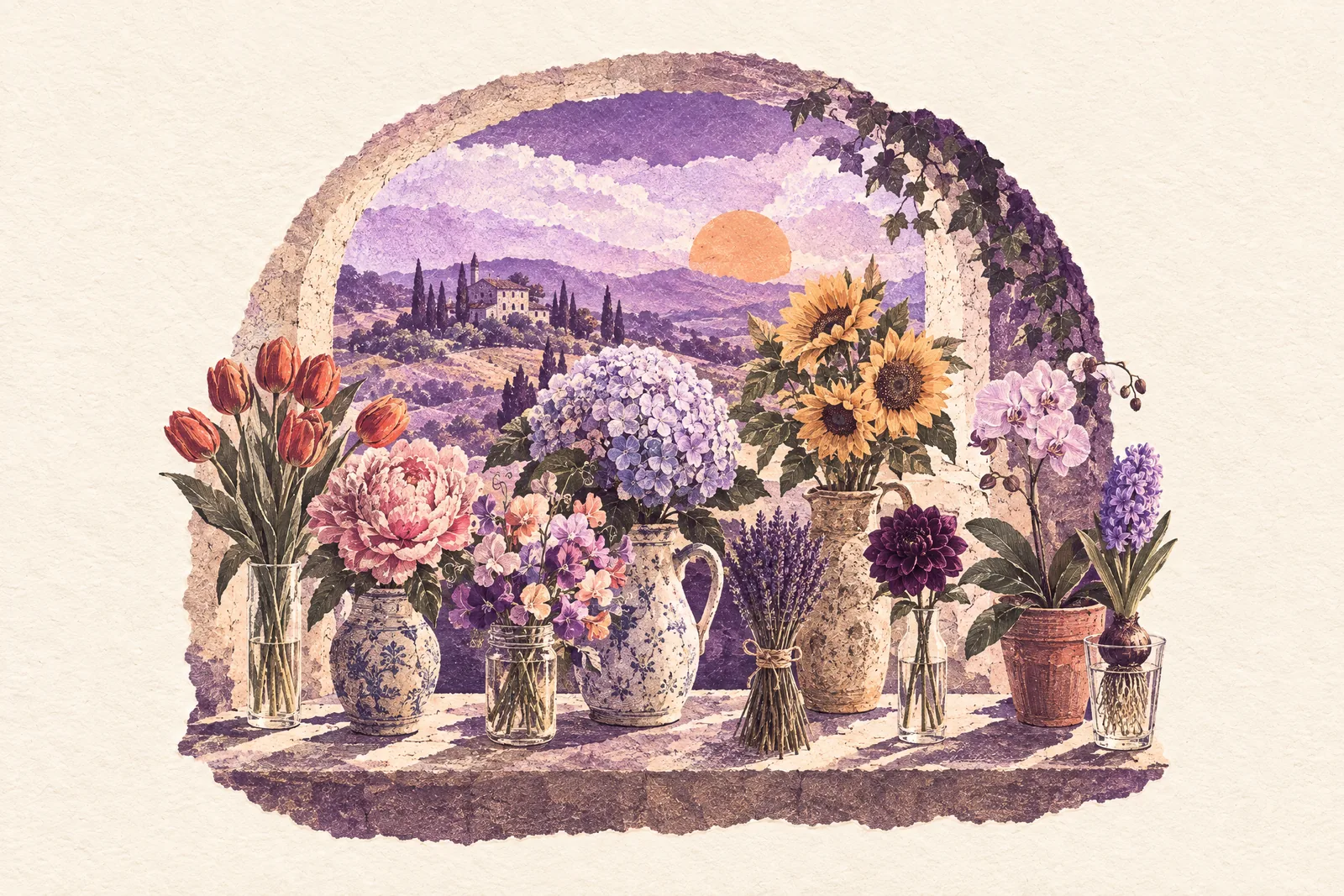
Maybe you buy the same bunch of grocery-store flowers every week and reorder the same candle every few months. Somewhere in that rotation is a flower that matches your sign more closely than you'd guess. The red tulip that pops open in March, all stem and blunt red cup? That's Aries kicking off the zodiac year. You just never put the two together.
You've seen the "your sign as a flower" charts floating around, and the picks probably felt arbitrary. Why a sunflower for Leo and not a daisy? Why lavender for Virgo and not a fern? Here, each pairing comes from three questions asked in order: what does the sign's element and modality look like as a plant, what's blooming when that sign falls on the calendar, and what does the flower actually do with its shape and color. A good match answers at least two of those three.
Scents follow the same logic. Each one is described by its notes (pepper, fig, bergamot, amber, plum, oud, cedarwood) the way a perfume counter would describe them, so you can track one down in a candle, a soap, a body mist, or a fragrance without guessing.
Spring signs: Aries, Taurus, Gemini
Aries: the red tulip, with pink pepper and ginger. Spring's boldest red. Aries opens the zodiac's year at the March equinox, and a tulip is a single clean cup on a straight stem: no ruffles, no fuss, cardinal fire getting straight to the point. The scent is pink pepper and ginger, bright and a little hot, the kind of top note that announces itself before you've finished saying hello. A bunch of red tulips in a plain glass, or a perfume that opens with pepper.
Taurus: the peony, with fig and sandalwood. A late-spring flower that starts as a tight, hard ball and then opens into something enormous and soft. Fixed earth takes its time and then commits completely, and a peony is exactly that: the golf-ball bud you ignored for two days that suddenly takes over the whole table. It's the most touchable flower on this list, heavy and layered and lush. The scent is fig and sandalwood, green and creamy and warm, the olfactory version of a blanket you already own. One fat peony in a vase by the bed.
Gemini: the sweet pea, with bergamot and lemon verbena. Ruffled, light, usually sold in mixed colors in a single bunch, with curling tendrils reaching off in every direction like they're halfway through several conversations at once. Mutable air loves variety and exchange, and sweet peas look like they'll start three more before they finish this one. The scent is bergamot and lemon verbena: sparkling citrus with a green edge, quick and bright and gone in an hour (the good kind of gone, the "oh wait, what was I saying" kind). A mixed-color bunch in a jar on the desk where you write.
Summer signs: Cancer, Leo, Virgo
Cancer: the hydrangea, with clean linen and soft musk. A single hydrangea stem is a whole crowd of small flowers gathered into one round head, which is Cancer's idea of belonging in a picture. The name even fits the water sign: "hydrangea" was coined in 1753 from Greek hydor, "water," and angeion, "vessel," after the shrub's cup-shaped seed pods.[1] Cancer's instinct is to pull people close, and a hydrangea on the kitchen table does the same for a room, rounding out the empty air. The scent is clean linen and soft musk, the smell of a freshly made bed you haven't gotten into yet. One big stem in a pitcher on the table everyone passes.
Leo: the sunflower, with amber and orange blossom. A high-summer flower with a face like a child's drawing of the sun: open, bright, impossible to overlook. Fixed fire holds its heat, and a sunflower in a jug holds a room's attention for days. A friend walks in, sees three of them, and says "okay, that's so you." The scent is amber and orange blossom, warm and golden and generous, the kind that fills a hallway before you see the person wearing it. Three sunflowers in a big jug where guests will see them first.
Virgo: lavender, with rosemary. Neat stems, tidy bundles, a flower people actually use: the sachet in the linen drawer, the bunch drying upside down in a kitchen window. Mutable earth refines and serves, and lavender is the flower of useful, well-kept things, as pretty in the field as it is tied with string in a sock drawer. The scent is lavender and rosemary, clean and herbal, the smell of a drawer you're glad you opened. A bundle tied with string in the sock drawer, so you smell it every time you get dressed.
Autumn signs: Libra, Scorpio, Sagittarius
Libra: the pink garden rose, with rose and pear. Petals spiral out from the center in near-perfect symmetry, and the rose is the flower people hand to each other to start something. Libra wants things fair and lovely at the same time, and a garden rose is beauty with good proportions, nothing wasted, nothing overdone. The scent is rose with pear: soft, polished, sweet without being heavy, the kind you catch from across a room and can't quite name. A few garden roses in a pretty vase on a table set for two (or for one, which is also lovely).
Scorpio: the dark dahlia, with plum and oud. Dahlias are an autumn florist's staple, and the darkest ones are burgundy edging toward black. Their petals are packed in tight, folded layers around a center you can barely see. Scorpio shows what it feels slowly and only up close, and a dark dahlia looks like it's keeping a secret in the middle of all that ruffled velvet. The scent is dark plum and oud: deep, smoky-sweet, meant to be noticed only when someone is already close enough. You test six perfumes at the counter and keep drifting back to the one with the smoky plum. A single dark dahlia in a bud vase.
Sagittarius: the carnation, with clove, cardamom, and cedarwood. Frank, cheerful, ruffled, and criminally underrated, which Sagittarius tends to enjoy. Carnations come in every color and look just as happy in a jam jar at a campsite as in a florist's window. Mutable fire goes looking for the wider world, and the scent follows it: clove, cardamom, and cedarwood, warm spice like a market in a city you haven't visited yet. A jar of mixed carnations next to the trip you're still planning.
Winter signs: Capricorn, Aquarius, Pisces
Capricorn: the amaryllis, with vetiver, pine, and leather. Grown from a bulb you start in the dark of the year and then wait on while a tall, straight stalk climbs before anything opens. Cardinal earth builds toward a result it can see from far off, and an amaryllis is patience with a very big payoff in the middle of winter, right in Capricorn season. It's architectural too: one stem, strong lines, no clutter. The scent is vetiver, pine, and leather, dry and woody and grown-up. One potted bulb on your desk at work, where you can watch the stalk climb through January.
Aquarius: the orchid, with ozonic notes. An orchid looks designed rather than grown: sculptural, a little strange, unlike anything else in the shop. Fixed air sticks to its convictions, and an orchid on a desk looks like an opinion you're not going to argue with. The scent is ozonic: cold air, rain on warm stone, a clean metallic sparkle that reminds you of the first breath after a storm clears. One potted orchid where you think.
Pisces: the hyacinth, with sea salt and water lily. A late-winter bulb that can bloom sitting in a glass just above water, its roots trailing where you can see them, and its heady scent fills a whole room. Mutable water lets things in and spreads out to fill the space it's given, and a hyacinth does that with smell alone. The color runs to blue-violet, the dreamiest end of this list. The scent is hyacinth itself, or watery notes: sea salt, water lily, soft musk. A bulb in a glass on the windowsill at the end of winter, making the kitchen smell like spring for a week.
The seasons behind the list
Western astrology's zodiac starts at the March equinox, so Aries lands in early spring and Pisces closes the year in late winter in the Northern Hemisphere. That's why this list runs from a spring bulb to a late-winter one. The seasons flip below the equator, so if you're reading from the Southern Hemisphere, the same flowers fit your sign by element and character; you just enjoy them off-season, which is half the fun.
A Big Three bouquet
Your Sun flower is the main stem. If you know your Moon sign, that flower goes on your side of the vase, because the Moon is the private one. The rising sign's flower faces out toward the room, since that's the face you show first. (The rising sign takes an accurate birth time to pin down; without it, skip the third stem.)
So an Aries Sun with a Taurus Moon and Libra rising gets a bunch of red tulips as the spine, one fat peony tucked in near you, and a garden rose or two angled toward the door. It's a playful way to see your chart as one arrangement rather than three separate ones.
Two quick notes: candles and cats
A lit candle stays in the room with you while it burns, which is part of why it's lovely: the scent is there because you're there. Blow it out when you leave.
If you live with a cat, true lilies and daylilies stay out of any bouquet. Every part of those plants is toxic to cats, including the pollen and the water in the vase, and a small amount can cause fatal kidney failure.[2] Mixed bouquets often slip lilies in, so check the stems before the bunch crosses the threshold.
Go get one stem
Pick your sign's flower this week. One tulip, one sweet pea, one dark dahlia, whatever is good at the market. And the next time you're at a perfume counter and the sales associate asks what you're looking for, you can say: pepper, or fig, or ozonic, or smoky plum. They'll know what you mean. Your sign already does.
Online Etymology Dictionary, hydrangea, entry 'hydrangea (n.).' ↩︎
U.S. Food and Drug Administration, Lovely Lilies and Curious Cats: A Dangerous Combination, opening section. ↩︎