Moon Phases and Transits
Eclipse Season in Astrology: What Eclipses Mean and What to Do
An eclipse is a new or full moon lined up with the Moon's nodes. Here's what solar and lunar eclipses mean in astrology and how to watch one safely.
Your lease renewal is due in two weeks, and your feed is already flooded with posts telling you to freeze all major decisions for the next thirty days. You pause over the lease paperwork and wonder whether you're supposed to wait six weeks before you do anything that matters.
Here's the actual situation. An eclipse is not a force field around your calendar. It's a new moon or a full moon that happens to line up with the Moon's orbital nodes, the two points where the Moon's tilted path crosses the Sun's. That alignment only comes around in two windows a year, each about five weeks long. Astrologers read eclipses as those familiar lunar phases with the volume turned up: moments that ask you to notice a shift already underway, not moments that will drop a lightning bolt into your life. A solar eclipse leans toward beginnings. A lunar eclipse leans toward culminations and endings. You can still sign the lease. You can still take the trip. You just pay a little closer attention while you do.
Solar eclipses and lunar eclipses, in plain terms
A solar eclipse happens when the Moon passes directly between the Sun and Earth, casting a shadow that fully or partly blocks the Sun's light across some stretch of the planet's surface. Solar eclipses occur at the new moon, when the Moon is already on the Sun's side of us.[1] In an annular eclipse, the Moon sits at or near its farthest point from Earth, looks slightly smaller than the Sun, and leaves a bright ring of fire around its dark disk. The other types are total, partial, and hybrid.
A lunar eclipse happens when Earth slides between the Sun and the Moon and Earth's shadow falls across the lunar surface. Lunar eclipses occur at the full moon, when the Moon is directly opposite the Sun. During a total lunar eclipse, the Moon often turns deep orange or rust-red, because the only sunlight reaching it has been filtered through the full thickness of Earth's atmosphere, which scatters away the bluer wavelengths. That filtering is where the nickname "blood moon" comes from.[2]
So the geometry is simple: solar eclipses are new moon events, and lunar eclipses are full moon events. The sign the eclipse falls in follows the Sun. A solar eclipse lands in the Sun's current sign. A lunar eclipse lands in the sign opposite the Sun.
Why eclipses come in seasons
You might wonder why eclipses don't happen every single month, since we get a new moon and a full moon every 29.5 days. The answer is a five-degree tilt. The Moon's orbit around Earth is tilted about five degrees relative to Earth's orbit around the Sun, which means in most months the new moon passes a little above or below the Sun, and the full moon drifts just past Earth's shadow. No alignment, no eclipse.
Twice a year, though, the new and full moons come close enough to the nodes, those crossing points, for a true alignment to happen. That window is an eclipse season: one of only two periods each year when the Sun, Moon, and Earth line up closely enough for eclipses to occur, each lasting about 35 days and returning just short of six months later.[3] Because a season stretches a little longer than one full lunar cycle, eclipses tend to arrive in pairs: a solar eclipse and a lunar eclipse separated by just over two weeks. There are four to seven eclipses in a typical year, which is why eclipse talk floods your feed for a few weeks and then vanishes for months.
The nodes themselves creep backward through the zodiac and spend roughly eighteen months on each pair of opposite signs. That's why eclipses keep landing on the same two signs for about a year and a half before shifting to the previous pair. Astrologers treat eclipse seasons as the moments the nodal axis is most active, tying them to the north and south node. One side of the axis describes what's familiar and well-worn; the other describes what's newer and less comfortable. Eclipses shake up that axis in ways a regular new or full moon doesn't quite manage.
What a solar eclipse means in astrology
Every solar eclipse is also a new moon, which already marks a fresh cycle. The extra nodal alignment gives it more weight as a starting point. Where an ordinary new moon might prompt you to start a side project or reorder a morning routine, a solar eclipse reads as a door swinging open in the area of life the eclipse's sign touches. A beginning that asks for more attention than you'd normally give.
On the day itself, watching what starts to appear suits a solar eclipse better than sitting down with a ten-point list of intentions. Something may surface in a conversation, a random idea you can't stop turning over, a practical opportunity that lands in your inbox. A single honest line in your notes is plenty. You don't have to script the whole chapter. You just mark where the door is.
What a lunar eclipse means in astrology
Every lunar eclipse is also a full moon, the phase that already brings things to a visible peak. The nodal alignment amplifies that sense of completion. Where an ordinary full moon might highlight a tension you've been feeling for a week, a lunar eclipse reads as a culmination: a stretch of effort coming to its natural head, a role you've been rehearsing that's ready to be lived, a habit you've been outgrowing that finally snaps into "okay, I'm done with that."
An ending is usually just the last page of a stretch you walked through on purpose. The eclipse lights the exit so you can see the whole shape of what's closing. It also helps that a total lunar eclipse is a beautiful thing to step outside for, with the Moon turning copper-red overhead.
Finding the eclipse in your own chart
If you work with whole sign houses, the entire rising sign counts as the 1st house, and each sign that follows in zodiac order becomes the next house. So the eclipse's sign falls somewhere in your chart, and that house's territory is where astrologers tell you to watch for what's shifting.
Say you have a Leo rising. Gemini is the 11th house for you, the house of friends, groups, community, and collective hopes. A Gemini eclipse that season reads through friendships, a group you're part of, a community goal, or a hope you've been quietly building toward.
This needs an accurate birth time and birth place, because your rising sign depends on the exact moment and location of your birth. If you don't have that information, you still get the eclipse's sign and its general flavor, which is its own useful layer. You don't need the house to notice what the sign is doing.
How to watch an eclipse safely
Now for the safety rules, which are honestly simple.
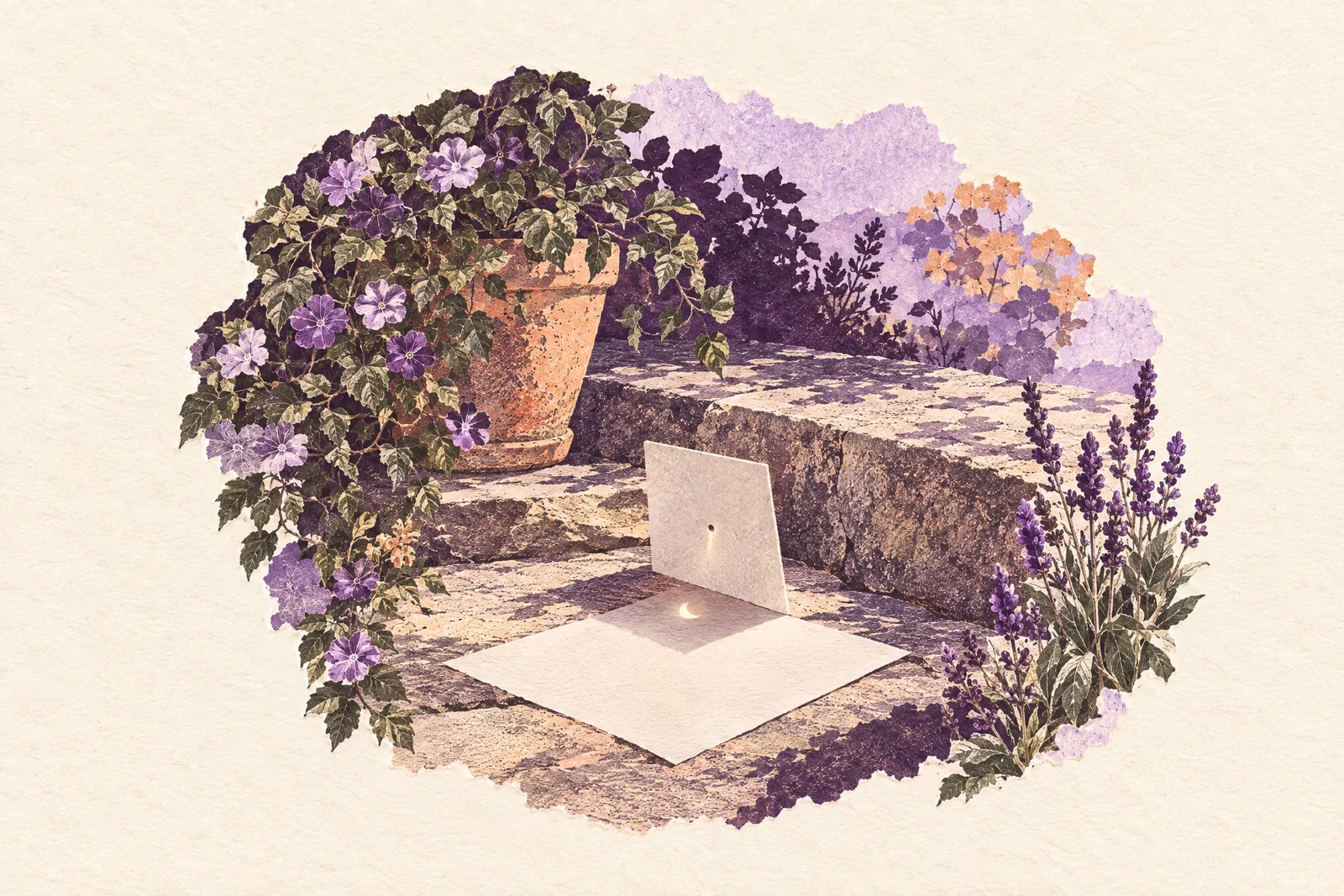
Except during the brief total phase of a total solar eclipse, it is not safe to look directly at the Sun without specialized eye protection rated for solar viewing. Regular sunglasses, however dark, are not safe. Solar viewers should meet the ISO 12312-2 standard, and you can find certified pairs from astronomy retailers. A pinhole projector is a safe indirect way to watch: punch a small hole in a card, hold it up, and let a tiny crescent Sun appear on the sidewalk below.[4]
During partial and annular solar eclipses, including the bright ring phase of an annular eclipse, it is never safe to look directly at the Sun without proper eye protection. After totality, eclipse glasses go back on the instant any bright sliver of Sun reappears. And no one should look at the Sun through a camera lens, telescope, binoculars, or any optical device while wearing eclipse glasses or a handheld viewer.[4:1]
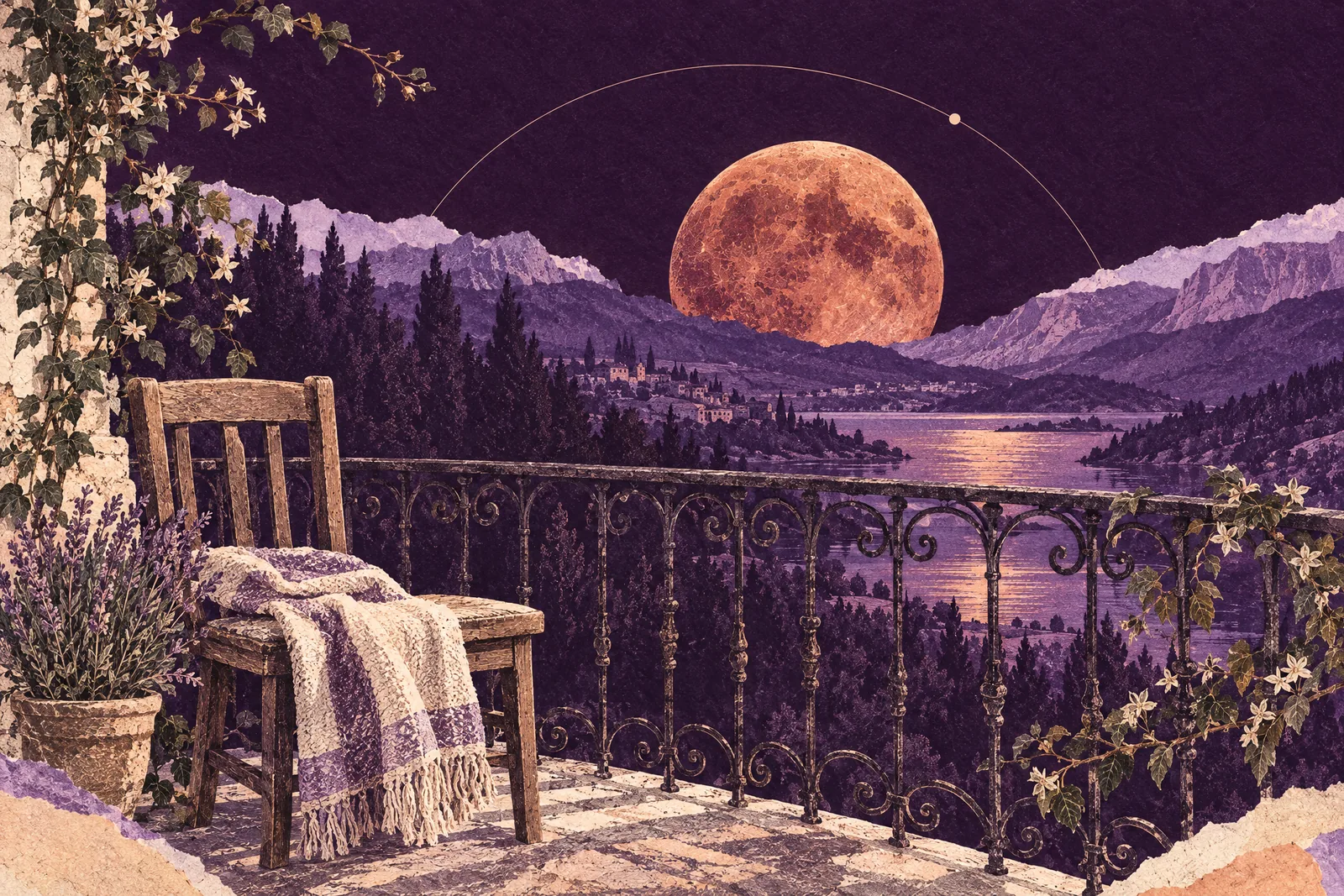
Lunar eclipses are a different story. They are safe to watch with the naked eye or through a telescope during all types and stages. The Moon comes up rust-orange over the tree line, and you stay on the balcony much longer than you meant to. That's the whole protocol.
An eclipse-season practice that stays calm
Open a note in your phone or a small paper log. Every few days during the five-week window, jot a line or two on three things: what's starting, what's wrapping up, and what keeps coming up uninvited. A few sentences will do.
Keep signing leases, going on dates, taking the trip, answering the work email. Think of eclipse season as a slightly brighter reading lamp over whatever is already in motion.
When the season closes, read your entries back. Circle the one thread that appeared in almost every note. That's the thread worth pulling into the next six months.
What happens next
The next eclipse season arrives just under six months after this one. Before you close this tab, check a published eclipse calendar or astrology app and note which pair of opposite signs this season's eclipses fell on. Watch, next time around, whether the nodal axis has shifted to the previous pair yet or whether the same two signs are still doing the heavy lifting. It's a small way to feel the rhythm of the year without needing a guru to decode it for you.
NASA Science, Types of Solar Eclipses, sections on each type of solar eclipse and on lunar eclipses. ↩︎
NASA Science, Eclipses and the Moon, section on how a blood moon works. ↩︎
NASA Science, Eclipse Safety, eye safety guidance for solar eclipses. ↩︎ ↩︎