Sun Signs
Zodiac Sign Dates: The Twelve Ranges (and Why the Edges Move)
The twelve zodiac date ranges are a good map of the year with fuzzy borders. Here are the dates, why the edges move, and when your birth time decides it.

Your friend was born on March 20, and she's been living a double life. One website says she's a Pisces, another swears she's an Aries, and for years she's read both horoscopes and kept whichever one had better news. Neither site lied to her. They were both rounding off the same moving line.
That line can run right through a single day. In 2026, the Sun crossed into Aries at 10:46 a.m. on March 20, New York time. A baby born in New York at 9 that morning was a Pisces. A baby born at noon in the same city was an Aries. Same date, two signs. The twelve zodiac date ranges are a great map of the year, but the borders are fuzzy: the middle of every range is solid, and the edges need a closer look.
Zodiac sign dates at a glance (approximate)
Each range starts on the date the Sun most often entered that sign, in Universal Time, for births from 1990 to 2030. In US time zones, several of these changes land a day earlier.
| Sign | Approximate dates | Element | Modality |
|---|---|---|---|
| Aries | March 20 to April 19 | Fire | Cardinal |
| Taurus | April 20 to May 20 | Earth | Fixed |
| Gemini | May 21 to June 20 | Air | Mutable |
| Cancer | June 21 to July 21 | Water | Cardinal |
| Leo | July 22 to August 22 | Fire | Fixed |
| Virgo | August 23 to September 22 | Earth | Mutable |
| Libra | September 23 to October 22 | Air | Cardinal |
| Scorpio | October 23 to November 21 | Water | Fixed |
| Sagittarius | November 22 to December 20 | Fire | Mutable |
| Capricorn | December 21 to January 19 | Earth | Cardinal |
| Aquarius | January 20 to February 17 | Air | Fixed |
| Pisces | February 18 to March 19 | Water | Mutable |
Read down the last two columns and you'll see a rhythm: the elements repeat in a fixed order (fire, earth, air, water) and so do the modalities (cardinal, fixed, mutable), so every season holds exactly one sign of each modality.
Capricorn is the sign that straddles New Year, which is how a Christmas baby and a mid-January baby end up sharing a sign.
Most birthdays never get near a border. When your little cousin asks what sign she is and her birthday is the 8th, you can tell her without opening a single app, because the 8th sits comfortably inside every range on the list.
Why the zodiac year starts in March
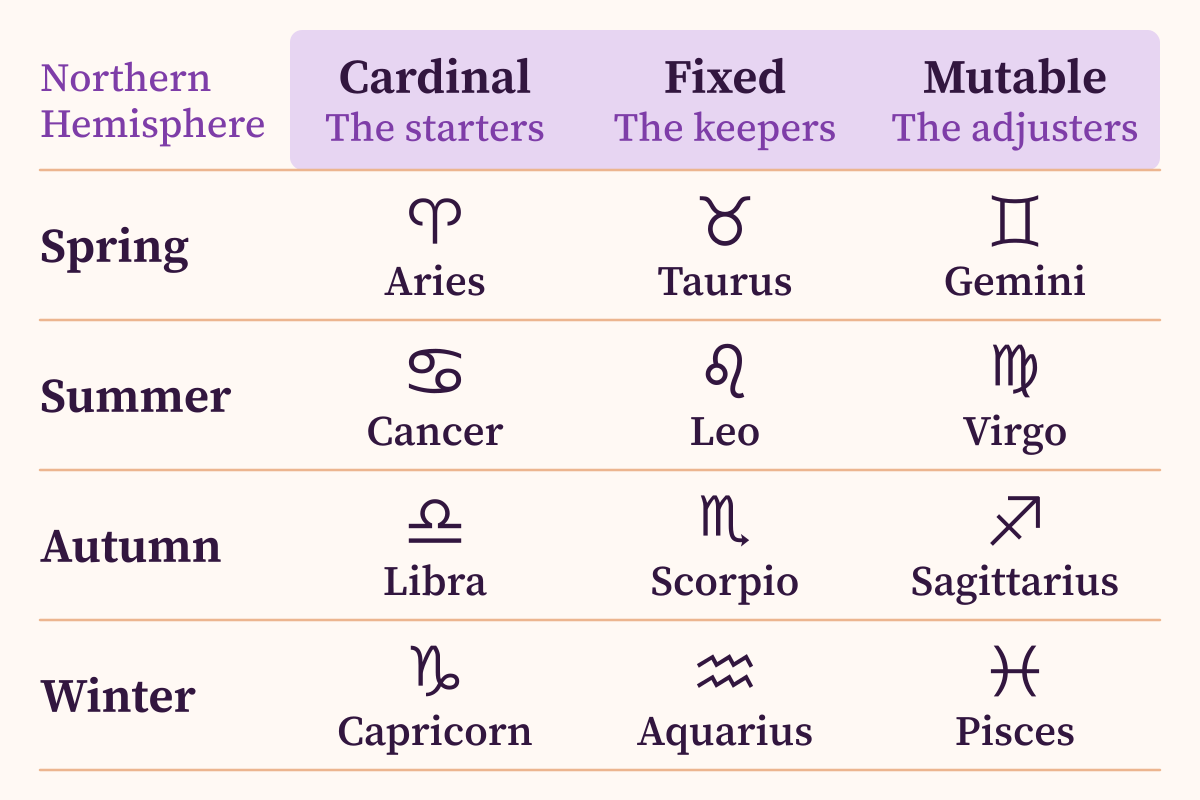
Western astrology uses the tropical zodiac: twelve equal 30-degree slices of the sky, counted from wherever the Sun stands at the March equinox. That spot is called the First Point of Aries, so Aries leads the list and January doesn't get a vote. Every other start date follows from there.
Count forward three signs at a time and you hit the other turning points of the year. The Sun reaches 0 degrees, the start of Aries, at the March equinox. It reaches Cancer at the June solstice, Libra at the September equinox, and Capricorn at the December solstice. Those four are the cardinal signs, the modality of starting things, and each one opens a season: spring, summer, autumn and winter in the Northern Hemisphere. South of the equator the seasons flip, so the March equinox opens autumn there, but the signs themselves stay exactly the same everywhere.
Once you spot the four season-openers, the whole table clicks. A fixed sign holds the middle of each season (Taurus, Leo, Scorpio, Aquarius), and a mutable sign carries it out the door (Gemini, Virgo, Sagittarius, Pisces).
Why the edges move every year
Each sign begins at an exact instant, the moment the Sun reaches it. That instant doesn't sit still on the calendar, and two things push it around.
The leap-year wobble
A year of seasons runs a little longer than 365 days. So each ordinary year, the March equinox (and with it the start of Aries and every sign after it) arrives about 5 hours 49 minutes later than the year before, and each leap year pulls it back about 18 hours, which keeps it from drifting more than about a day from March 20.[1]
Picture a line that creeps forward for three years and snaps back on the fourth. In Universal Time, the March equinox usually lands on March 20, though it can fall as early as March 19 or as late as March 21; the last March 21 was in 2007, and the next won't come until 2102.[1:1] Because the equinox date shifts a little from year to year, the start date of Aries, and so of every other sign, can shift slightly too.[2]
Time zones
The Sun enters a sign at one moment for the whole planet, but that moment carries a different local date depending on where you are. The March equinox fell at 03:07 Universal Time on March 20, 2024, which was 11:07 p.m. on March 19 in New York, and at 14:46 Universal Time on March 20, 2026, which was 10:46 a.m. on March 20 in New York.[1:2]
Sit with 2024 for a second. A New Yorker born at 11:30 that night, still on March 19 by the local clock, was already an Aries. In 2026, a New Yorker born on March 20 had to arrive after 10:46 a.m. to be one. A website that rounds everything to Universal Time and an app that uses your local clock can both be doing honest work and still disagree by a day. That's the entire story behind your friend's two horoscopes.
Born near the edge?
Every month the Sun moves into a new sign somewhere between the 19th and the 23rd, and for a birthday in that window the time of birth can decide the sign. Across every year from 1930 to 2035, in time zones from Hawaii to New Zealand, the Sun reached each sign somewhere between the day before the table's start date and two days after it.
That gives you a simple rule. If your birthday is the last day of a range, or one of the first three days of the next one, the table can't settle your sign. Anywhere else in a range, trust the table.
You're writing a birthday card for a coworker and want to add her sign. Her birthday is the 21st, the one date where every chart you look up seems to disagree. What settles it is her birth date, birth time and birthplace in a chart calculator, which converts the local time with the right time zone and daylight saving rules and tells you where the Sun actually was. It takes seconds.
Or your partner insists he's a Cancer, his sister insists he's a Gemini, and the tiebreaker is sitting on his birth certificate, in the time box.
If the Sun changed signs on your birthday and you don't know your birth time, your Sun sign may stay uncertain until you find it. A birth certificate or a hospital record can close the gap. Reading both descriptions and picking the one that sounds more like you doesn't work, because a description can't tell you where the Sun was. And if you've always wondered whether you're a little of both, the cusp question has its own guide.
If you've seen very different dates
Some posts claim the zodiac dates changed, or list a thirteenth sign. Those dates come from sidereal astrology or from the constellations, which measure the sky differently; in the sidereal zodiac, the Sun enters Aries around April 14. Zodiac signs and constellations aren't interchangeable, and the dates in the table above are the tropical zodiac, counted from the equinox. Whether your sign really changed gets its own guide too.
Find your birthday in the table
Run your finger down to your own birthday. If it's sitting on an edge, run your chart with your date, time and place, and you'll know in seconds which side of the line you landed on. If it's safely in the middle, read across the row.
The element and modality are the first two words of your sign's story. Fire acts and gets excited, earth makes things real, air thinks and talks, water feels and takes things in. Cardinal starts, fixed keeps going, mutable adapts. The zodiac signs guide picks up from there.
As for your March 20 friend, once she runs her chart she'll get one of two rows: water and mutable, or fire and cardinal. Either way, she can finally stop reading two horoscopes.
Wikipedia, March equinox, lead section and equinox table. ↩︎ ↩︎ ↩︎
Wikipedia, Astrological sign, 'Western astrological correspondence chart.' ↩︎